
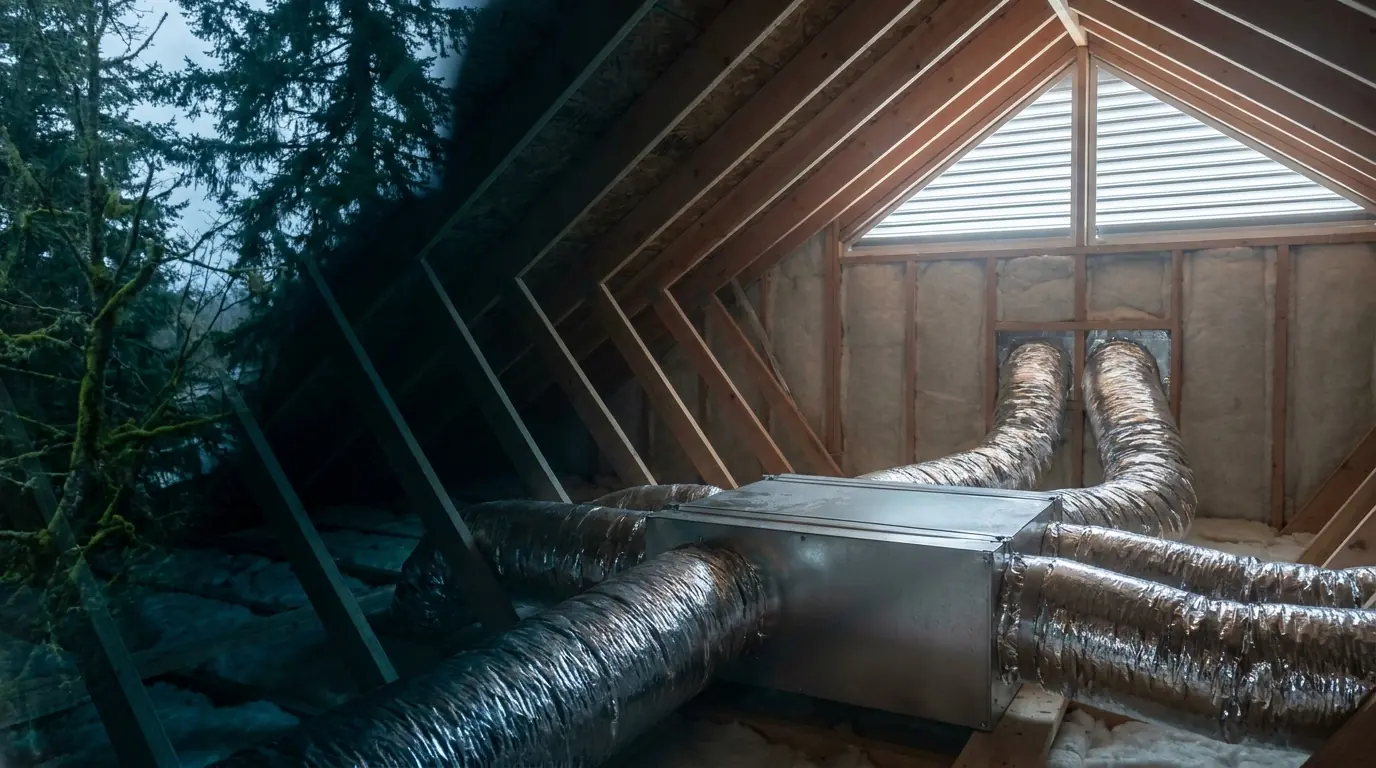
Ductwork Installation in Seattle, WA
Custom sheet metal ductwork fabricated and installed serving Capitol Hill, Ballard, West Seattle, and all of Seattle. No subcontractors, all permits pulled, built to exceed WA code. Served by Seattle City Light, not the utility most rebate articles assume.
Your Seattle Ductwork Specialists
Seattle homeowners in Capitol Hill, Ballard, and West Seattle often discover that ductwork is the silent culprit behind comfort and efficiency problems. Even newer homes in Seattle can have ductwork problems: builder-grade installs frequently use undersized trunk lines, excessive flex duct, kinks at takeoffs, and unsealed boots. The result is hot rooms, cold rooms, high energy bills, and HVAC equipment running harder than it should.
Seattle is the one city in our area where the money is in getting off oil, not off gas — and Seattle City Light runs its own program, so the rebate tables written for the rest of the region do not apply to you. The bonus tier closes for installs completed after September 30, 2026, so here the calendar matters as much as the paperwork.
The Washington State Energy Code lists Seattle at a 24°F winter design temperature (WAC 51-11C-80100, Table C-1). That is the number a Manual J load calculation for your home is run against, and it is the difference between duct runs sized for the real load and duct runs sized for a guess. Natural gas here comes from the local gas utility. In Seattle we most often find oil furnaces and gravity "octopus" furnaces in pre-1940 Craftsman and Tudor stock, gas forced air in remodeled homes, and electric wall heaters in un-ducted bungalows — so we quote what your house actually has, not what the average Puget Sound home has.
Ductwork Services for Seattle Homes
Why Seattle Homeowners Choose Us
Fast Response
Based in Federal Way, we reach Seattle quickly for ductwork inspections and estimates. Most ductwork projects are scheduled within a week of approval.
Know Local Codes
The mechanical permit for your duct system is issued by Seattle Department of Construction & Inspections (SDCI). We pull it, pay the fee, book the inspection and meet the inspector on site. Exterior work in Seattle may also go before the Seattle Landmarks Preservation Board and the neighborhood historic districts (Ballard Avenue, Columbia City, Pioneer Square, Harvard-Belmont).
Understand Local Homes
In Seattle we usually find oil furnaces and gravity "octopus" furnaces in pre-1940 Craftsman and Tudor stock, gas forced air in remodeled homes, and electric wall heaters in un-ducted bungalows. We size to your house at the 24°F design temperature the state energy code sets for this area — not to a rule of thumb. Near Elliott Bay and Shilshole Bay we specify corrosion-rated coils.
Ductwork Challenges for Seattle Homes
Who bills you for power decides what you can claim. Seattle is served by Seattle City Light. That means a $2,000 instant rebate for oil-to-heat-pump conversions on qualifying equipment, plus up to $4,000 more for moderate-income households (81–150% AMI) on installs completed by Sept 30, 2026. Seattle's program runs through participating installers and qualifying equipment, and the bonus tier closes for installs completed after September 30, 2026 — the calendar matters as much as the paperwork.
Seattle does not share Seattle's weather, and the code says so. The Washington State Energy Code lists Seattle at a 24°F winter design temperature (WAC 51-11C-80100, Table C-1). That is the number a Manual J load calculation for your home is run against, and it is the difference between duct runs sized for the real load and duct runs sized for a guess. Renton is 21°F — a real gap for towns this close together. Seattle is the milder side of that line, and equipment sized for the colder neighbor is equipment you paid too much for.
What we expect to find in a Seattle home. The local stock runs to Craftsman bungalows from the 1910s-1920s, Tudor Revivals, mid-century ranches, modern townhomes, and high-rise condos downtown. That usually means oil furnaces and gravity "octopus" furnaces in pre-1940 Craftsman and Tudor stock, gas forced air in remodeled homes, and electric wall heaters in un-ducted bungalows. Gas service here comes from the local gas utility. Whether reworking a duct system is the right answer for your house is something we tell you after we look at it, not before.
The parts of the job that are specific to this address. In Seattle, the mechanical permit is issued by Seattle Department of Construction & Inspections (SDCI), and we pull it, pay it and meet the inspector; exterior work may go before the Seattle Landmarks Preservation Board and the neighborhood historic districts (Ballard Avenue, Columbia City, Pioneer Square, Harvard-Belmont), so where the outdoor unit sits is a permitting decision here, not just an aesthetic one; homes near Elliott Bay and Shilshole Bay get corrosion-rated coil coatings and a twice-yearly coil rinse instead of annual service — salt air is what kills condensers early on this shoreline; burn bans and wildfire-smoke advisories here are called by Puget Sound Clean Air Agency, which is the season that makes filtration worth specifying properly.
Quick Facts
Local details that change a duct system job in Seattle
Seattle is not on the utility most heat pump rebate advice on the internet assumes, which quietly invalidates it. The facts below are the ones that actually apply to your meter.
- Electric utility
- Seattle City Light
- Natural gas
- the local gas utility
- Winter design temp
- 24°F WSEC Table C-1, WAC 51-11C-80100
- Mechanical permit
- Seattle Department of Construction & Inspections (SDCI)
- Rebate program that applies
- Seattle's Clean Heat program
- Burn bans & smoke advisories
- Puget Sound Clean Air Agency
- Heat we usually find
- oil furnaces and gravity "octopus" furnaces in pre-1940 Craftsman and Tudor stock, gas forced air in remodeled homes, and electric wall heaters in un-ducted bungalows
- Salt-air exposure
- Elliott Bay and Shilshole Bay — corrosion-rated equipment recommended
- Design / historic review
- the Seattle Landmarks Preservation Board and the neighborhood historic districts (Ballard Avenue, Columbia City, Pioneer Square, Harvard-Belmont)
“Vlad and his team were extremely professional. Constant communication, clean workmanship, and reasonable pricing.”
— Darius T., Federal Way, WA
Ductwork Questions from Seattle Homeowners
Ductwork projects in Seattle typically range from $3,450 to $9,200, depending on scope. A partial replacement of a few crushed or leaking runs is at the lower end. A complete custom-fabricated duct system for a 2,000-3,000 sq ft home with all-new trunk lines, mastic sealing, and R-8 insulation is at the higher end. We provide free in-home assessments with written, itemized estimates.
Yes. The mechanical permit is issued by Seattle Department of Construction & Inspections (SDCI), and Washington State requires one for this work. We handle the whole thing — application, fee, and meeting the inspector for the final — so you never contact the permit desk yourself. In Seattle, exterior equipment may additionally need sign-off from the Seattle Landmarks Preservation Board and the neighborhood historic districts (Ballard Avenue, Columbia City, Pioneer Square, Harvard-Belmont), which we factor into placement before we quote. Every install meets or exceeds the current Washington State mechanical and energy codes.
Most ductwork projects in Seattle take 1-3 days. A targeted replacement of a few problem runs is often a one-day job. A complete duct system replacement paired with a new furnace or heat pump install runs 2-3 days, including commissioning and balancing. We schedule to minimize disruption and always leave your home clean.
Almost always, the cause is ductwork: undersized supply, missing or unbalanced damper, kinked flex duct, leaky takeoff, or no return air path. We diagnose the actual cause with manometer readings and airflow measurements — not guesses — and propose the smallest fix that actually solves the problem.
We fabricate our own galvanized sheet metal trunk lines, plenums, and transition fittings. We use rigid metal supply runs wherever possible and limit flex duct to short, properly supported connections at registers. All joints are sealed with mastic (not tape). All ducts in unconditioned space (attics, crawl spaces) are insulated to R-8 minimum. No subcontractors and no shortcut materials.
Often, yes — at minimum, you should have it inspected. A new high-efficiency furnace or variable-speed heat pump can lose 20-30% of its rated performance through leaky, undersized, or improperly sealed ductwork. If your existing ducts are 25+ years old, leaking visibly, or were sized for a smaller previous unit, it's almost always worth replacing or modifying them as part of the equipment install.
The Washington State Energy Code lists Seattle at a 24°F winter design temperature (WAC 51-11C-80100, Table C-1). That is the number a Manual J load calculation for your home is run against, and it is the difference between duct runs sized for the real load and duct runs sized for a guess. A cold-climate heat pump holds its rated capacity well below that, which is why heat pumps genuinely work here rather than being a compromise. Gas here comes from the local gas utility, and for some homes a hybrid — heat pump for most of the year, gas furnace for the coldest mornings — is the right answer. We will tell you if it is.
Ductwork Near Seattle
Ready for a Free Ductwork Estimate in Seattle?
Honest pricing on ductwork installation, replacement, and modification — fabricated by our own sheet metal crew.