

How Loud Is a Heat Pump in Decibels, Really?
"Loud" is relative, so decibels only mean something next to sounds you already know. Here's how a modern heat pump stacks up against everyday noise:
| Sound Source | Approx. Decibels (dBA) |
|---|---|
| Mini-split indoor head (low/quiet mode) | 19 – 30 dB |
| Refrigerator hum | ~40 dB |
| Modern heat pump, outdoor unit (low/quiet mode) | 45 – 52 dB |
| Normal conversation | ~60 dB |
| Dishwasher / modern heat pump on high | 55 – 60 dB |
| Older heat pump or AC unit (10+ years, worn parts) | 65 – 72 dB |
| Vacuum cleaner | ~70 dB |
The decibel scale is logarithmic, so a jump from 50 to 60 dB isn't a small step — it reads as roughly twice as loud to the human ear. That's why the gap between a well-placed modern outdoor unit and a tired old condenser wheezing on its last summer matters more than the spec sheet numbers suggest.
Are Heat Pumps Louder Than a Furnace or an Old AC Unit?
Not really, though the comparison isn't perfectly apples-to-apples. A gas furnace's noise stays indoors, usually tucked in a utility closet or basement, so you mostly hear it as a low blower hum through the vents. A heat pump adds an outdoor unit to the equation, which is new sound if you're used to a furnace-only system — but it's the same category of sound a central AC condenser has always made sitting next to the house.
Where heat pumps actually win is against old equipment of either kind. A worn compressor, a fan bearing on its way out, or a cabinet that's lost some of its insulation over the years all get louder with age, whether it's a furnace, an AC unit, or a heat pump. A properly sized, newly installed heat pump is almost always quieter than the failing system it's replacing.
Not Sure What a Quiet Install Looks Like for Your Home?
Tell us where the unit would go and what's nearby — a bedroom window, a shared fence line, a patio — and get a real quote with placement already factored in.
Where Should the Outdoor Unit Go So You (and Your Neighbors) Don't Hear It?
Placement changes what you actually hear day to day more than the unit's rated decibel level does. A few things a good installer thinks through before the pad ever goes down:
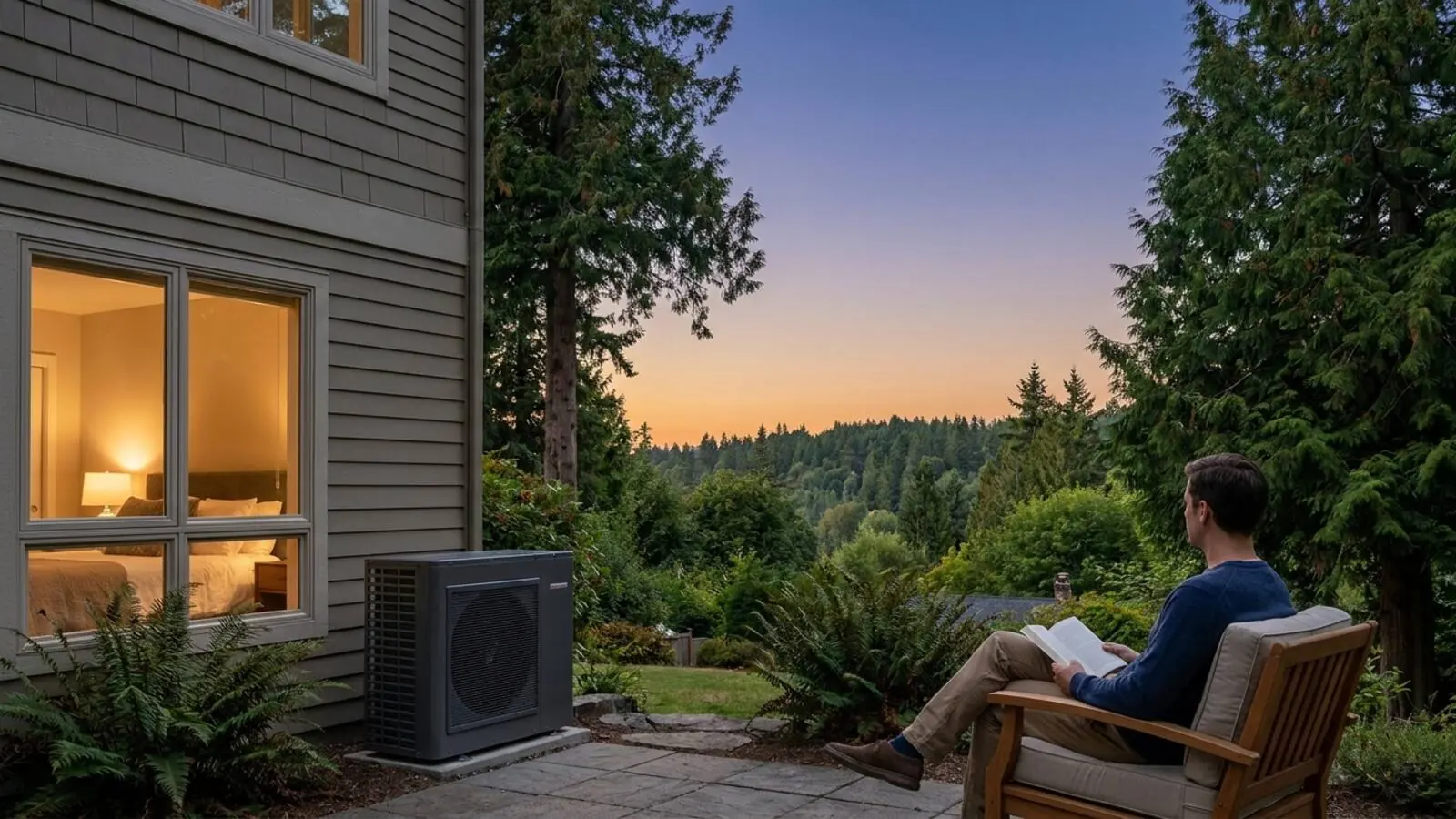
- Keep it away from bedroom windows. A unit humming 55 dB right below a window you sleep with cracked open is a very different experience than the same unit set near a garage wall.
- Avoid tight corners and enclosures. Sound bounces off fences, retaining walls, and siding in an alcove, which can make a quiet unit sound louder than its rating. A little open space around the unit lets sound dissipate instead of reflecting.
- Mount it on a solid, vibration-dampening pad. A unit bolted to a wobbly deck or thin concrete can transmit vibration into the structure of the house, which reads as noise indoors even when the outdoor decibel level is normal.
- Think about shared property lines. On tight urban and suburban lots common across the Puget Sound area, the unit that's convenient for your side yard might sit close to a neighbor's patio or window on the other side of the fence.
None of this is complicated, but it does take someone actually walking the site and asking the questions before the equipment shows up — not just finding the nearest electrical disconnect and setting the pad there.
Do Local Noise Ordinances or HOA Rules Affect Heat Pump Placement?
Many Puget Sound cities and counties have general noise ordinances that apply to mechanical equipment, and a mechanical permit is required for a heat pump installation regardless of which jurisdiction you're in. Varsity pulls the required permit as part of every job and can flag placement concerns relative to property lines during the estimate, before anything is installed.
If you're on an unusually tight lot, live in a townhome or condo with shared walls, or belong to an HOA with its own equipment placement rules, it's worth checking those specific requirements directly — they vary enough between neighborhoods that we'd rather point you to the source than guess on your behalf.
Ducted Heat Pump or Ductless Mini-Split — Which Is Quieter?
Both systems share the same outdoor unit, so the outdoor noise picture is similar between the two. The difference shows up indoors. A ductless mini-split head mounted on the wall runs its own small fan, and on low or quiet settings that's often in the 19–30 dB range — quieter than a whisper, and easy to forget is even running.
A ducted whole-home system moves air through your existing ductwork instead, and the sound you notice there is less about the heat pump itself and more about duct design. Undersized or poorly sealed ducts create air noise at the registers no matter how quiet the outdoor unit is; ducts sized correctly for the airflow move air quietly. If your ducted heat pump sounds like a wind tunnel at the vents, that's usually a ductwork problem, not an equipment problem.
What Makes One Heat Pump Quieter Than Another?
Every Varsity quote comes in Good, Better, and Best equipment tiers, and noise is one of the places that tier actually shows up. Entry-level units typically run a single-speed or two-speed compressor that's either fully on or fully off, which means it spends more time running at its loudest setting. Higher tiers usually add variable-speed compressors that modulate output to match the load, so the system runs at a lower, quieter speed most of the time instead of cycling between off and full-blast.
Fan blade design, cabinet insulation, and mounting hardware matter too — features that happen to reduce noise are often the same features that improve efficiency, which is part of why the quietest option on a quote is rarely the cheapest one. It's worth asking directly which tier gets you the meaningfully quieter unit versus which one just changes the brand name.
Why Did My Heat Pump Get Louder Over Time?
A heat pump that used to be background noise and now announces itself is telling you something. A few common causes, roughly from cheapest fix to most involved:
- Debris in the outdoor unit. Leaves, cottonwood fluff, and yard debris caught in the fan or coil add rattle and reduce airflow. Clearing it is often a five-minute fix.
- Loose access panels. A panel that's vibrated loose over time buzzes against the cabinet. Usually just needs tightening.
- Ice buildup. A heat pump working harder to push air through ice-restricted coils runs louder than normal — occasional light frost is expected, but heavy buildup usually points to a repair need.
- Worn fan motor or bearings. A grinding, squealing, or rattling sound that wasn't there before usually means a part is wearing out, not something a cleaning will fix.
- Failing compressor. The most serious cause and the one most worth calling about — a compressor on its way out is often loud well before it fails completely.
Routine maintenance handles the first two or three on that list. Anything that sounds mechanical — grinding, squealing, a new rattle that won't go away — is worth a real diagnosis rather than waiting it out. Our heat pump repair team can tell you in one visit whether it's a quick fix or something bigger.
If you're shopping for a new system and noise is a real concern — a bedroom window close to the pad, a shared fence line, a home office right off the patio — say so up front. Placement and equipment tier both get factored into the quote, not bolted on after the fact. Call (253) 785-4622 or get a free estimate to talk through your specific layout.
Heat Pump Noise FAQs
Most modern outdoor heat pump units run 55 to 60 decibels on high speed and drop to roughly 45 to 52 decibels in low or quiet mode. That's about as loud as a dishwasher or a normal conversation, and noticeably quieter than an aging AC unit or an old heat pump nearing the end of its life.
Not really. A furnace's noise stays indoors in a utility room or closet, while a heat pump adds an outdoor unit, so the two aren't a perfect apples-to-apples comparison. But a modern heat pump's outdoor unit is engineered to run no louder than a typical outdoor AC condenser, and indoor sound from the air handler or ductless heads is usually quieter than a furnace's blower. Older or failing equipment of either type tends to get louder with age.
Away from bedroom windows and shared property lines when the layout allows it, set on a solid, vibration-dampening pad rather than bare dirt or a wobbly deck, and with a few inches of clearance from fences or siding that can reflect sound back toward the house. A good installer walks the site with noise in mind before the unit ever gets set.
Many local jurisdictions have general noise ordinances, and a mechanical permit is required for the install regardless of city. Varsity pulls the required permit on every job and can advise on placement relative to property lines before the unit goes in. If you're on an unusually tight lot or in an HOA with its own equipment rules, it's worth checking those specific requirements too.
Sometimes. Ice buildup, debris caught in the fan, loose access panels, and dirty coils all add noise and are often fixable with routine maintenance. A steady increase in noise on a system that used to run quietly is more often a sign of a worn fan motor, failing compressor, or refrigerant issue that needs a real repair rather than a cleaning.