
What's the 60-Second Decision Rule?
Homeowners agonize over this choice for weeks. Contractors let them, because confusion sells upgrades. Here's the rule we actually use when we walk into a Puget Sound home:
- Your home has ducts in decent shape? A central ducted heat pump is usually the better value. One outdoor unit, your existing vents, whole-home comfort, nothing new on your walls.
- Your home has no ducts? Baseboards, wall heaters, hot water heat — ductless mini-splits win, and it usually isn't close. Cutting a duct system into a finished home means opening walls, ceilings, and floors. Mini-splits skip all of it.
- One problem room? The bonus room over the garage, the addition the old system never reached, the primary bedroom that's always the wrong temperature — a single-zone mini-split fixes exactly that room without touching the rest of the house.
That rule settles the question for most homes in about a minute. The rest of this article covers the money, the trade-offs, and the edge cases where the answer genuinely is "either one."
What Does Each System Cost Installed?
Real installed ranges for the Puget Sound region in 2026 — the same numbers behind our mini-split cost guide and heat pump cost guide:
| System | What It Covers | Installed Price |
|---|---|---|
| Central (ducted) heat pump | Whole home, through existing ductwork | $12,000 – $18,000 |
| Mini-split, single zone | One room or open living area | Toward $8,000 |
| Mini-split, multi-zone | 3–4 rooms, one outdoor unit | Toward $14,000 |
Premium markets like Bellevue and Gig Harbor run higher for both — larger homes, tighter site conditions, and higher-tier equipment push ducted systems toward $24,000 and multi-zone mini-splits toward $19,000. Every Varsity quote comes in Good, Better, and Best tiers either way, so you see exactly what each step up buys.
Notice what the table implies: a multi-zone mini-split covering most of a house costs about the same as a ducted system. That's why the ductwork question decides this — if the ducts already exist, you're paying mini-split prices for partial coverage. If they don't, you're comparing $8,000–$14,000 in mini-splits against a ducted system plus $3,000–$8,000 of new ductwork carved into finished walls.
How Do They Heat and Cool Differently?
A central heat pump works like the forced-air furnace you probably grew up with: one outdoor unit, one indoor air handler, and conditioned air delivered to every room through vents. It's invisible, it's even, and it treats the whole house as one space on one thermostat. Filtration happens at one central filter, and the equipment lives in the garage, closet, or crawlspace — not in your line of sight.
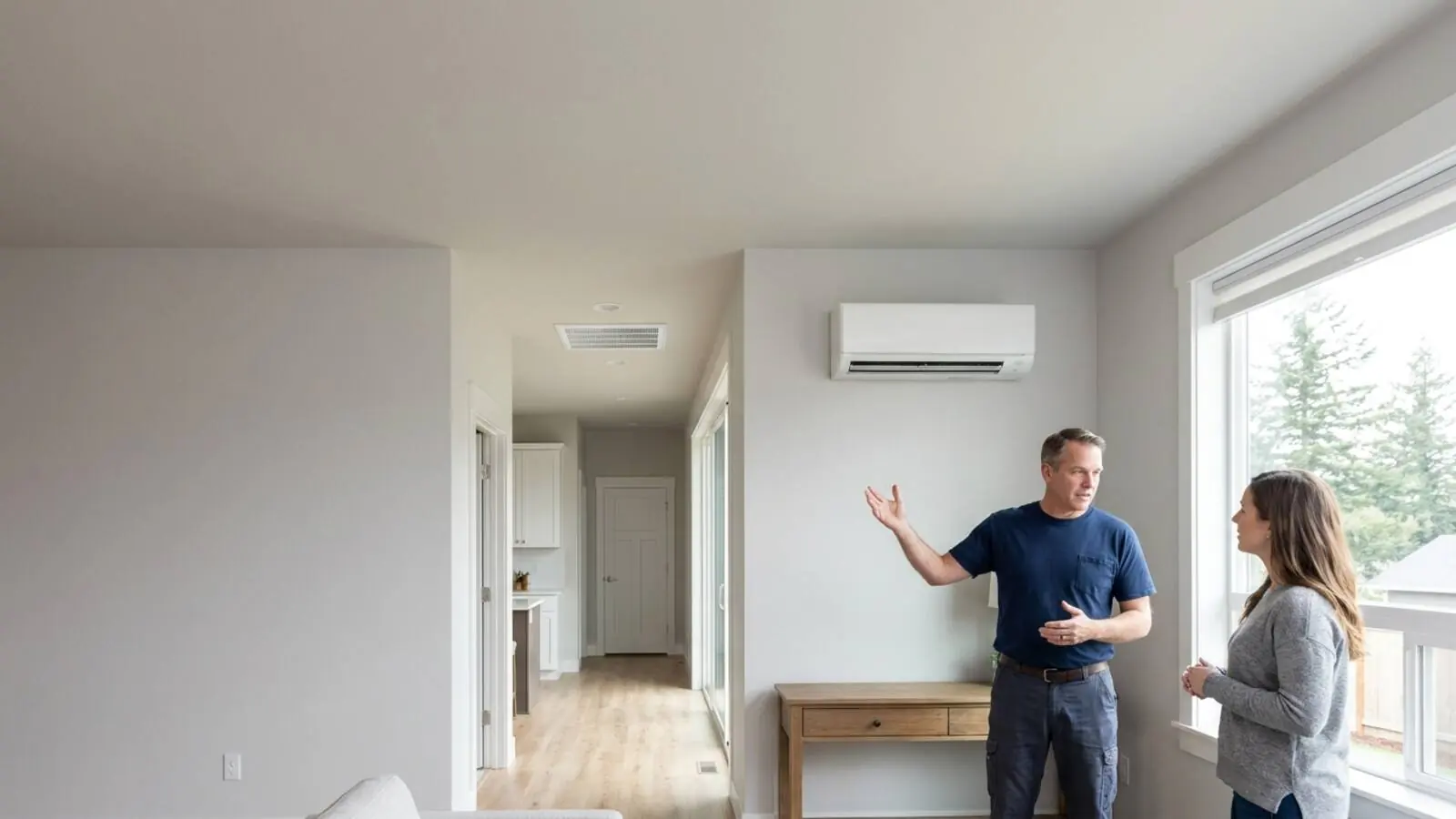
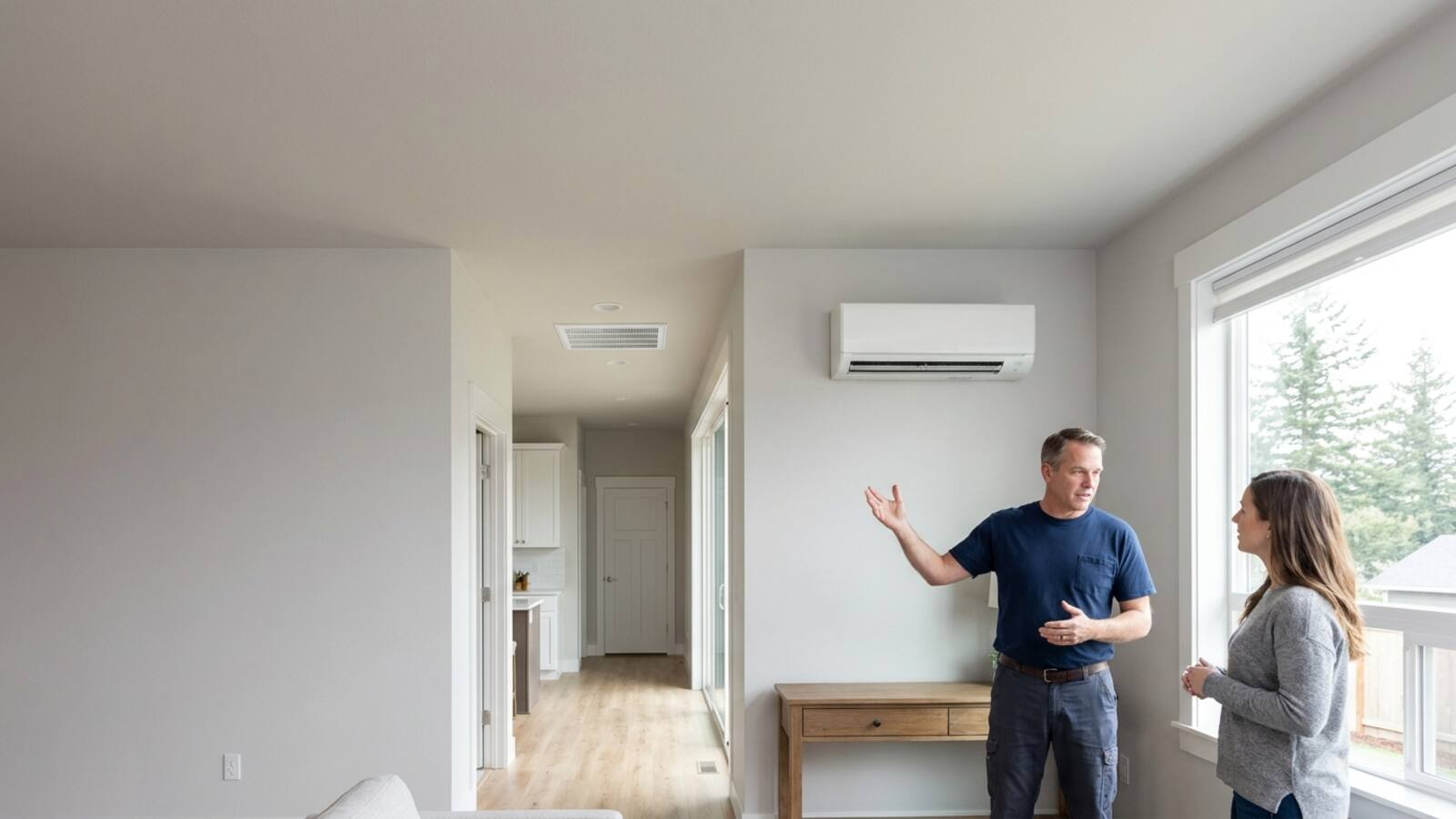
A mini-split flips that model. Each indoor head is its own little heating and cooling plant, mounted on the wall of the room it serves and connected to the outdoor unit by refrigerant lines run through a three-inch hole. No ducts, no vents — each room gets its own airflow, its own temperature, its own remote. One outdoor unit can feed one head or four.
Both are heat pumps underneath. Both heat and cool. Both thrive in Western Washington's mild marine climate, where winter temperatures rarely drop below the range where heat pumps run at their best. The difference isn't the technology — it's how the comfort gets delivered.
Not Sure Which Side of the Rule You're On?
Tell us about your home and get a genuine estimate in about 60 seconds — or book a free in-home estimate and we'll look at your ducts (or lack of them) in person.
What's the Zoning Advantage?
This is the mini-split's genuine superpower, and it's worth real money every month: you only heat and cool the rooms you're actually using.
A central system conditions the whole house to one temperature — including the guest room nobody's slept in since March. A mini-split lets you run the living room at 70°F all evening, keep the bedrooms at 64°F until an hour before bed, and leave the office head off entirely on weekends. Every head is its own thermostat.
Zoning also ends the classic two-story temperature battle. Heat rises, so upstairs bakes in July while the main floor stays comfortable — and one central thermostat can't satisfy both floors at once. Separate zones upstairs and down mean each floor gets its own setting, and the argument is over.
Central systems can be zoned too, with dampers and multiple thermostats, but it adds cost and complexity. With mini-splits, zoning isn't an upgrade — it's just how they work.
Will You Hate Looking at a Wall Head?
Here's the part of the sales pitch most contractors skip: some people genuinely hate wall-mounted heads, and no efficiency number changes that. A mini-split head is a white plastic cabinet roughly three feet wide sitting high on your wall — in the living room, in the bedroom, in every zone you condition. Modern units are slim and quiet, but they are not invisible, and if you've spent years getting a room exactly right, you may resent it daily.
Two honest counterpoints. First, ceiling cassettes exist — recessed units that sit nearly flush with the ceiling — and slim ducted mini-split air handlers can hide in a soffit or attic to serve a couple of rooms through short duct runs. Both cost more than wall heads, but they solve the aesthetic objection. Second, a central system wins this category outright: registers in the floor or ceiling and nothing else to see. If invisibility matters to you and you have ducts, that's one more point for central.
Our advice: stand in your living room and picture the head on the wall before you sign anything. If your jaw tightens, say so — there's usually a layout that works.
Which System Is More Efficient?
On paper, mini-splits usually win — and the reason is the ducts, not the equipment.
Ducted systems lose energy moving air through the duct runs, and in many Northwest homes those ducts live in unconditioned crawlspaces and attics. Every leaky joint and uninsulated run down there is heat you paid for warming the space under your floor instead of your living room. Duct leakage is one of the most common energy wasters we find in homes around here. Mini-splits skip the problem entirely: the refrigerant lines deliver heat directly to each room with essentially nothing lost in transit.
But the gap isn't fixed. Well-sealed, well-insulated ducts close most of it — and if your ducts are rough, sealing or repairing the ductwork is a far cheaper fix than abandoning the whole distribution system. When we quote a ducted heat pump, the duct condition is part of the assessment, because a high-efficiency unit pushing air through leaky ducts is wasted money.
The honest summary: mini-splits are more efficient by default; ducted systems can get close when the ductwork is sound. Either one will run circles around electric baseboards, where homeowners typically cut heating costs 30–50%.
Which One Do Rebates Favor?
In 2026, the rebate math leans toward the mini-split side — specifically for duct-free homes.
Most local electric utilities pay a rebate for converting electric resistance heat to a qualifying heat pump, and the classic qualifying case is exactly the home where mini-splits shine: baseboards or wall heaters, no ducts, converting to a ductless system. If that's your house, a rebate is effectively built into your project. What it's worth depends on your utility, what you're replacing, and the equipment that goes in, and income-qualified households can often stack more on top.
Ducted heat pump conversions can qualify for utility incentives too, depending on what you're replacing. One thing that no longer applies to either side: the federal 25C tax credit ended December 31, 2025 — anyone promising you a federal tax credit on a 2026 install is behind the times.
Two caveats we put in writing: rebate programs change, so we confirm what your utility currently pays before you sign anything and we file the paperwork. And utility rebates pay out only through the program's own approved contractor network, with requirements that get rewritten from year to year — so we check the current rules for your address before quoting rather than after. Hire a contractor who skipped that step and the rebate can evaporate.
What Does Varsity Recommend for Your Situation?
After a thousand-plus Puget Sound installs, here's how the decision actually breaks:
- Forced-air home, ducts in decent shape: central ducted heat pump. Best value, whole-home coverage, nothing on your walls.
- Baseboard or wall-heater home, no ducts: multi-zone mini-splits. Cheaper than adding ducts, dramatically cheaper to run than resistance heat, and utility conversion rebates apply.
- One problem room or an addition: single-zone mini-split. Fix the room; leave the rest of the system alone.
- Ducts exist but they're wrecked: we price both paths — duct repair plus a central system versus going ductless — and show you the math.
- Garage conversion, ADU, or bonus room the old system never served: mini-split, almost every time.
And when it's genuinely close — it happens — we quote both. Good, Better, Best tiers either way, most installs done in one day, and every installation backed by a 10-year parts AND labor warranty. You pick the system; either way it's covered for a decade.
Mini-Split vs. Central Heat Pump FAQs
If your ductwork is in good shape, a central (ducted) heat pump is usually the better value — most Puget Sound installations run $12,000 to $18,000 and deliver even, invisible whole-home heating and cooling through your existing vents. If the ducts are leaky or undersized, have them evaluated first; sealing or repairing them often costs far less than abandoning them.
In the Puget Sound region, a single-zone mini-split runs toward $8,000 installed, and a multi-zone system covering three to four rooms pushes toward $14,000. A ducted whole-home heat pump runs $12,000 to $18,000. Premium markets like Bellevue and Gig Harbor run higher for both system types.
Yes — that is exactly what they are built for. Each indoor head heats and cools its own room, so homes with electric baseboards or wall heaters get modern heat pump comfort without the cost and mess of retrofitting ducts into finished walls and ceilings. That is why mini-splits are the standard answer for older duct-free homes around Tacoma and Olympia.
Yes. Local utility rebates for converting electric resistance heat — baseboards, wall heaters, or an electric furnace — to a qualifying heat pump are common, and the baseboard-to-mini-split conversion is the classic qualifying case. Amounts and rules vary by utility and the programs change, so we verify what your own utility currently pays before you sign anything.
Most Varsity Heating installations are completed in a single day — single-zone mini-splits are often the fastest jobs we do. Multi-zone layouts or projects with ductwork modifications can take 1 to 2 days. Either way, every installation includes a 10-year parts and labor warranty.