
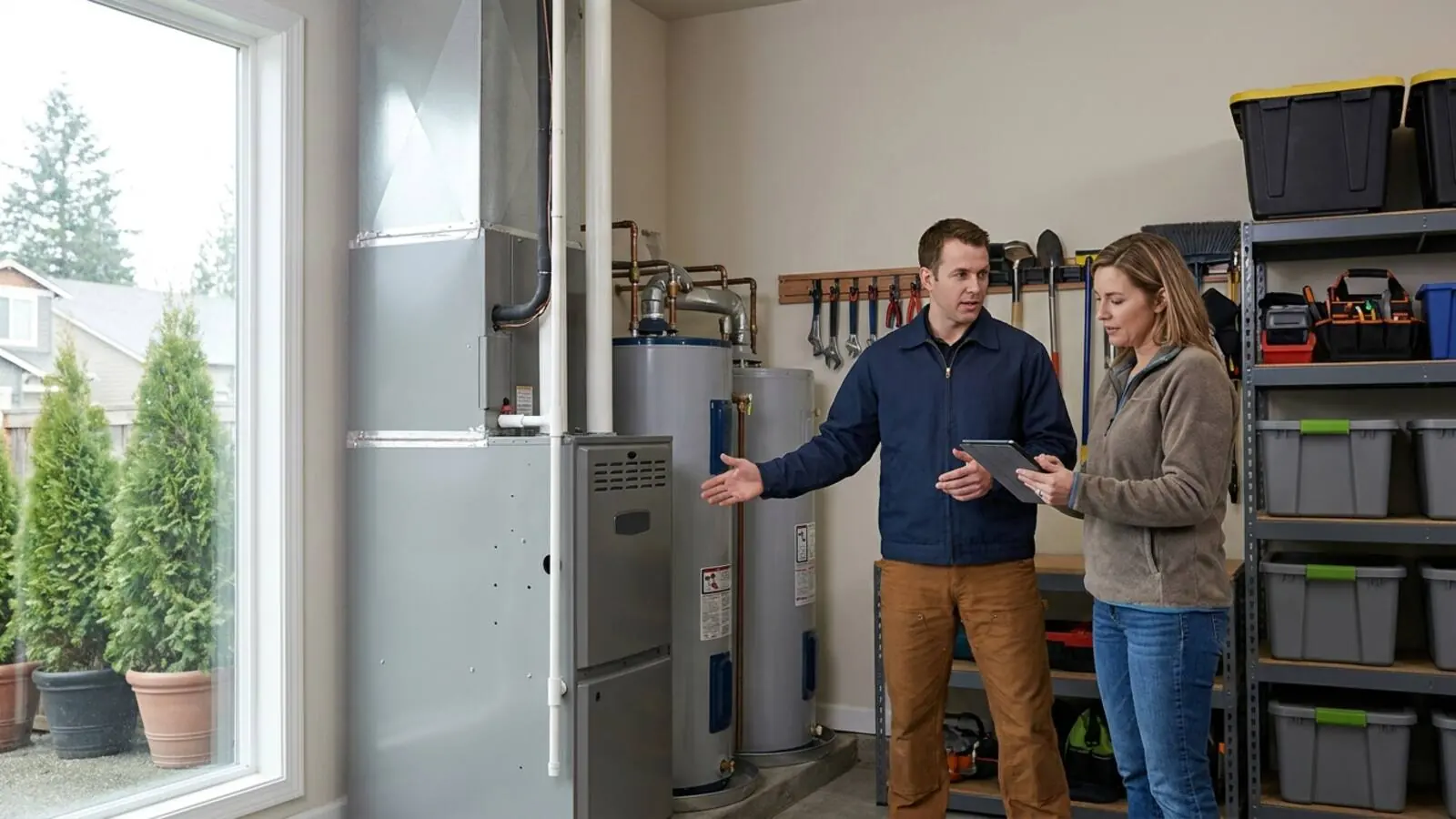
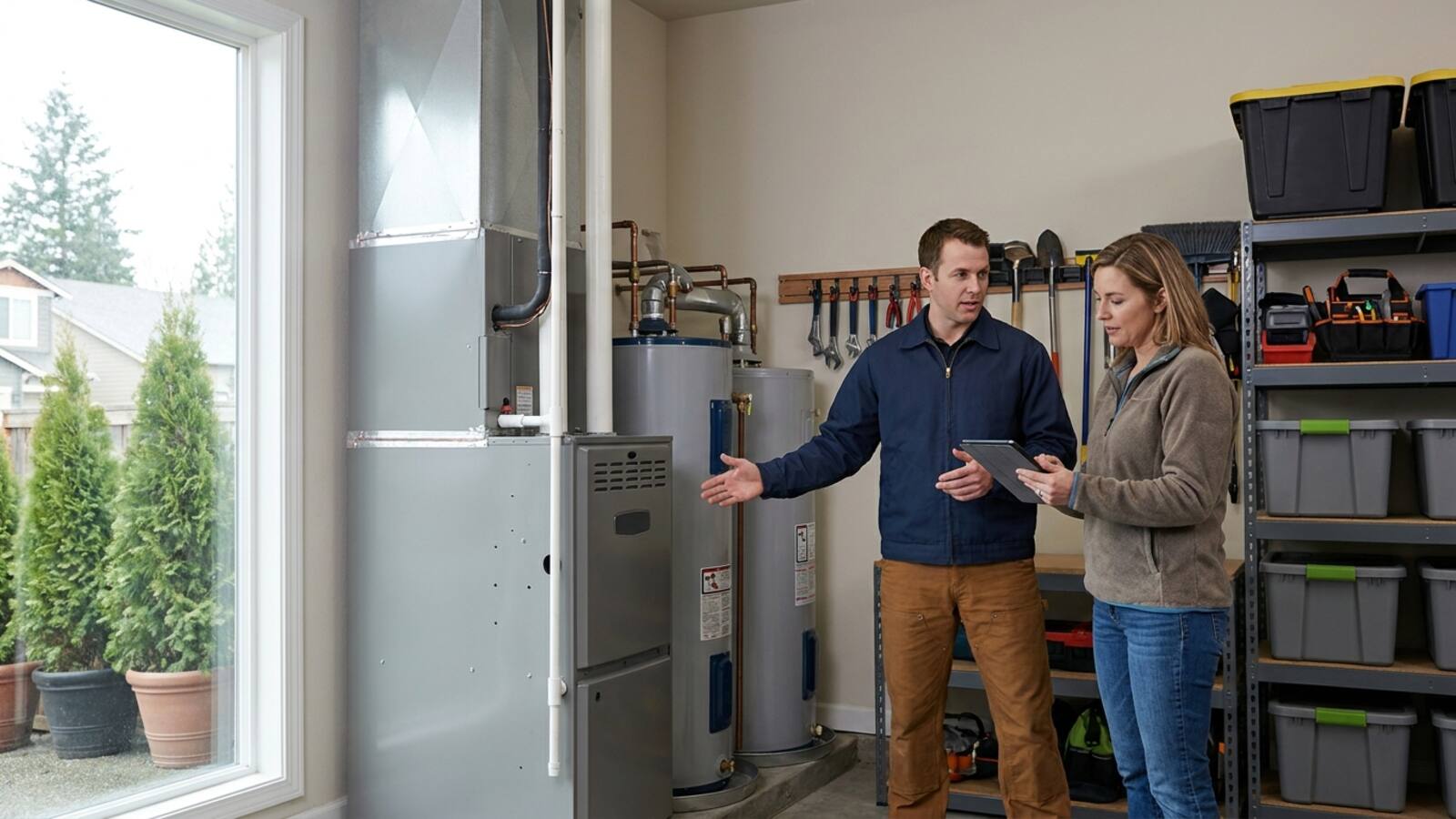
What Does Each System Cost Upfront?
Here's where every comparison article cheats: they put a $14,000 heat pump next to a $6,000 furnace and let you gasp. That's not an honest comparison, because the two numbers don't buy the same thing. A furnace heats. A heat pump heats and cools. Here are the real Puget Sound ranges we quote every week:
| System | Installed Cost (Standard Homes) | What You Get |
|---|---|---|
| Ducted heat pump | $12,000 – $18,000 | Heating AND cooling in one system |
| Gas furnace replacement | $4,000 – $8,000 | Heating only |
| Central AC (added separately) | $5,000 – $12,000 | Cooling only — what furnace homes add later |
| Hybrid heat pump (heat pump + gas furnace backup) | $12,000 – $18,000 | Heat pump does most of the work; your gas furnace covers cold snaps |
Run the like-for-like math. A furnace plus separate central AC lands at $9,000–$20,000 for two systems, two sets of equipment to maintain, two eventual replacements. A ducted heat pump covers both jobs for $12,000–$18,000 — one outdoor unit, one air handler, one warranty. The moment cooling enters the conversation, the "furnaces are cheaper" argument mostly evaporates.
Two more levers move the heat pump number. Equipment comes in Good, Better, Best tiers, so you control where you land in the range. And local utility rebates apply to qualifying conversions — programs change, so we confirm your current eligibility and handle the paperwork; the details are in our local utility rebate guide. If you want the full price breakdown by system type and home size, we published the numbers in our Washington heat pump cost guide.
What Do They Cost to Run Every Month?
Honest answer: it depends on what you're heating with today.
If you have electric resistance heat — baseboards, wall heaters, an electric furnace — this isn't close. A heat pump moves heat instead of generating it, and homeowners making this switch typically cut heating costs 30% to 50%. This is the single strongest case for conversion in Western Washington, and it's exactly the conversion utility rebate programs are built to target.
If you have natural gas, the monthly math is closer, and anyone quoting you a precise savings number is guessing. It depends on your utility's current gas and electric rates, your home's insulation, and how efficient your existing furnace is. Some gas homes save money switching; for others it's roughly a wash on the heating bill alone. We won't invent a figure to close a sale.
Want to sanity-check it yourself? Your utility bills show your gas and electric rates. Those numbers, plus your furnace's age and efficiency rating, are what an honest contractor plugs into the comparison — and it's exactly what we walk through on an estimate before recommending anything.
But the bill comparison misses something: the heat pump replaces your air conditioner too. If you're running — or planning to buy — central AC, the heat pump absorbs that entire cost and workload into one system. Compare "gas furnace + AC" against "heat pump," not "furnace" against "heat pump," and the operating picture shifts noticeably.
Which System Heats More Comfortably?
This is the part nobody puts in a spreadsheet, and it's the thing homeowners mention most after switching.
A gas furnace heats in blasts: it roars on, pushes hot air hard, hits the thermostat number, and shuts off. Then the house slowly cools until it roars on again. You feel the swings — hot vents, then drafts, then hot vents.
A modern heat pump runs longer, gentler cycles at lower output, holding your set temperature in a steady band instead of sawing above and below it. The air from the vents is warm rather than scorching, rooms stay more even, and variable-speed units are quiet enough that most homeowners stop noticing them entirely. If you've only ever lived with furnace heat, steady-state comfort is the upgrade you didn't know you were missing.
One caveat we'll own: a furnace's supply air is hotter, and some people genuinely love that blast-of-heat feeling on a cold morning. If that's you, it's a fair point for the furnace — or for a hybrid that gives you both.
Want the Math for Your House?
Tell us what you're heating with now and we'll give you an honest side-by-side — heat pump, furnace, or hybrid — with Good, Better, Best pricing and every rebate you qualify for. Our instant estimate tool takes about 60 seconds.
Does Western Washington's Climate Favor One?
Yes — and it favors the heat pump, decisively.
Heat pumps are at their best in mild winters, and the Puget Sound region has one of the mildest in the country. Our temperatures rarely drop below 25°F, which is squarely inside the efficiency sweet spot where a heat pump delivers its cheapest heat. The "heat pumps fail in the cold" stories you've heard come from places with real winters — and even there, modern cold-climate units have largely closed the gap. We're not going to scare you in either direction: this simply isn't a climate where heat pump performance is a concern.
Meanwhile, our summers have changed. Puget Sound homes that never needed cooling now face heat waves most summers, and a furnace has no answer for that. A heat pump was built for exactly this climate: mild, damp winters and increasingly warm summers, one system handling both.
What About a Hybrid System?
A hybrid — also called dual-fuel — pairs a heat pump with a gas furnace and lets the system choose. The heat pump carries the vast majority of the year, including all your cooling. When an unusual cold snap pushes past the changeover point, the system automatically switches to the gas furnace. No fiddling, no app, no thinking about it.
Who it fits: homes already on gas that want heat pump efficiency without giving up the furnace. If your gas furnace is mid-life and healthy, a hybrid lets it finish its career as a backup while the heat pump takes over the daily work — a gradual transition instead of a rip-and-replace. And because your existing furnace stays in place, a hybrid typically lands in the same $12,000–$18,000 range as a standard ducted heat pump install.
It's also the honest answer for the homeowner who just isn't ready to go all-electric. We'd rather install the system you'll be happy with than win an argument.
Is Washington Banning Gas Furnaces?
Let's take the temperature down on this one, because the headlines are doing a lot of fearmongering in both directions.
No one is coming to take the furnace you already own. You can keep running it, repair it, and replace existing gas equipment. What is true: Washington's energy codes and utility incentive programs increasingly favor electrification — new construction is steered hard toward heat pumps, and the rebate money flows toward conversions, not new gas equipment. The practical effect isn't a ban; it's a thumb on the scale. Over a 15-to-20-year equipment lifespan, the economics are being deliberately tilted toward heat pumps.
Our advice: don't buy anything out of panic — not a rushed heat pump because "gas is going away," and not a rushed furnace to "beat the ban." Neither panic is justified. Buy the system that fits your house and your budget on its own merits.
Which One Should You Actually Pick?
Skip the ideology. Here's how we'd call it, scenario by scenario:
- All-electric home (baseboards, wall heaters, electric furnace): Heat pump, full stop. The 30–50% heating savings is real, and utility conversion rebates target exactly your situation.
- No ductwork: A ductless mini-split heat pump. Retrofitting ducts into a finished home is invasive and expensive; mini-splits skip it entirely.
- Gas home that wants air conditioning: Heat pump or hybrid. You're about to spend AC money anyway — put it toward a system that also heats, instead of buying a cooling-only unit next to a furnace.
- Gas home, healthy mid-life furnace, no cooling need, tight budget: Maybe wait. Seriously. Run the furnace, bank the difference, and revisit when the furnace ages out or a heat wave changes your mind.
- Gas furnace at end of life: Decision time — this is the cheapest moment you'll ever have to switch, because you're spending replacement money either way. Compare a new furnace, a heat pump, and a hybrid on real quotes before defaulting to like-for-like.
- Want heat pump economics but nervous about ditching gas: Hybrid. The furnace stays as your safety net, and the heat pump proves itself on your actual bills.
The bottom line: in this climate, the heat pump is the right answer for most homes — but "most" isn't "all," and a contractor who recommends the same system to everyone isn't doing math, they're doing sales. We install heat pumps, furnaces, and hybrids. We'll tell you which one your house actually calls for.
Heat Pump vs. Gas Furnace FAQs
For most Western Washington homes, yes. The Puget Sound region's mild marine climate rarely drops below 25°F — the range where heat pumps run at their best efficiency — and one heat pump system covers both heating and cooling. Gas furnaces still make sense for some homes with existing gas infrastructure, and a hybrid system (heat pump plus gas furnace backup) can capture the strengths of both.
In the Puget Sound region, a ducted heat pump runs $12,000 to $18,000 installed, while a gas furnace replacement runs $4,000 to $8,000. But the furnace only heats — if you also want cooling, central AC adds $5,000 to $12,000 on its own. Compared like-for-like on heating plus cooling, the gap narrows considerably, and local utility rebates can bring the heat pump number down for qualifying conversions.
No one is coming to remove the gas furnace you already own, and you can still repair or replace existing gas equipment. What is true: Washington's energy codes and utility incentives increasingly favor heat pumps, especially in new construction. That shifts the long-term economics toward electrification, but there is no confiscation of existing equipment.
A hybrid (dual-fuel) system pairs a heat pump with a gas furnace. The heat pump handles the vast majority of your heating and all of your cooling, and the system automatically switches to the gas furnace during cold snaps. It's a good fit for homes already on gas that want heat pump efficiency without giving up the furnace, and it falls within the standard ducted heat pump range of $12,000 to $18,000 when your existing furnace stays on as the backup.
Not always. If your gas furnace is mid-life, running well, and you don't need cooling, waiting can be the right call — put the money toward the eventual replacement instead. If the furnace is near end of life, you want air conditioning, or you're paying for electric resistance heat anywhere in the house, that's when the heat pump math gets strong. Rebate programs change, so we confirm your current rebate eligibility before you decide.