
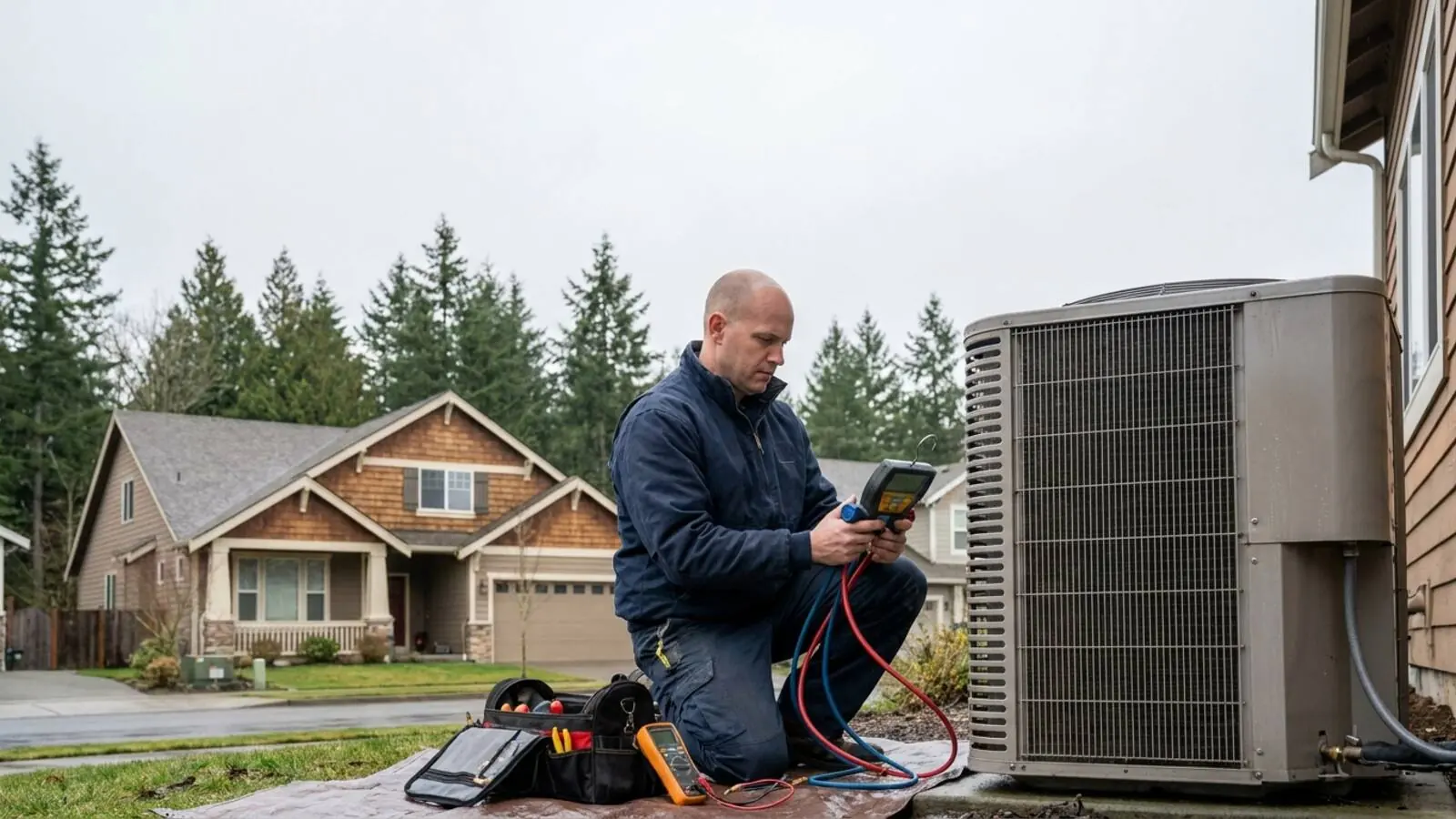
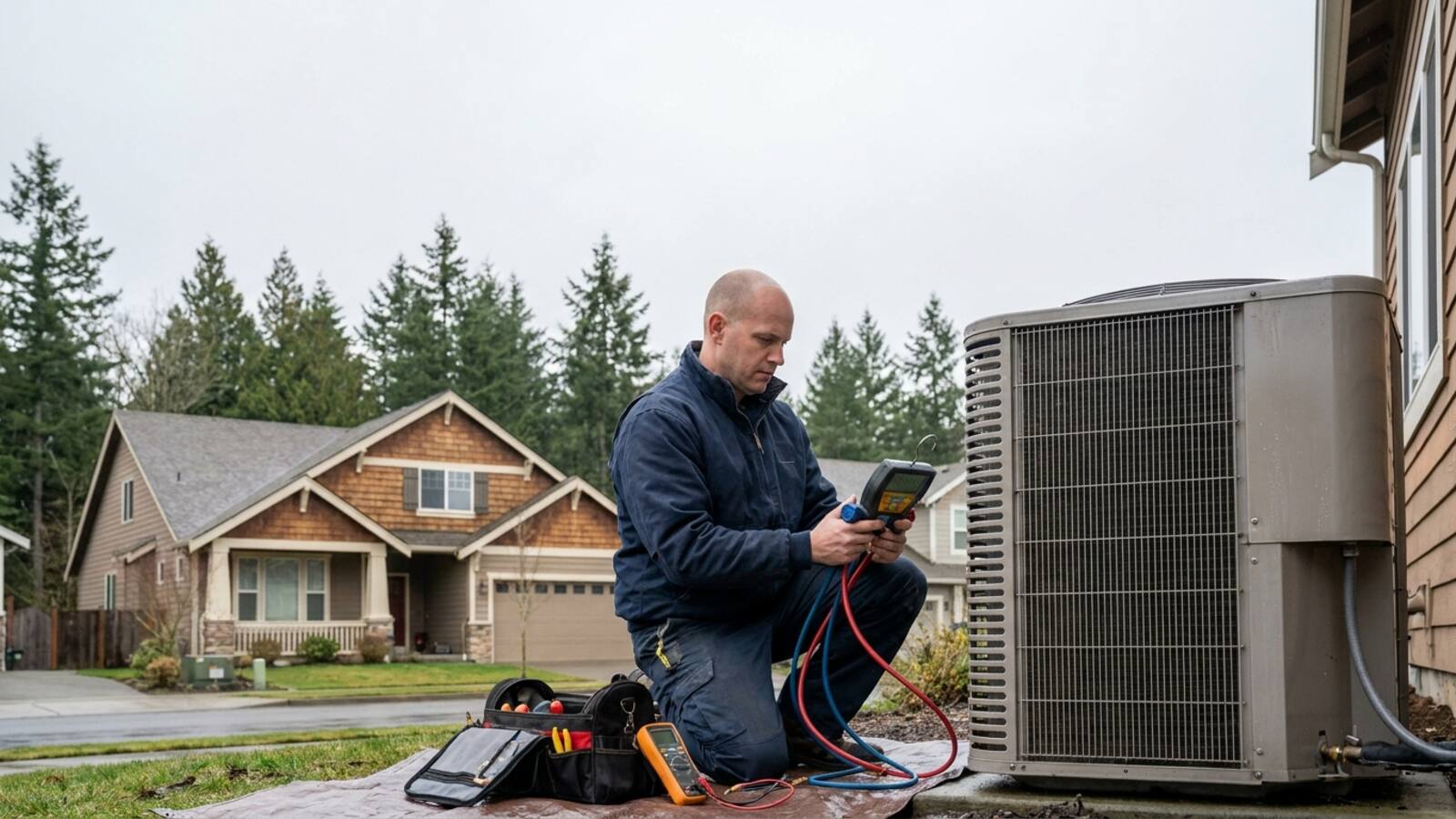
Is Your Heat Pump Actually Broken?
About half the "my heat pump died" calls we take don't end in a repair. They end with a thermostat setting, a tripped breaker, or a filter that hasn't been changed since the system went in. So before you book a heat pump repair visit, work through this list in order — it's sorted from free-and-takes-two-minutes to needs-a-licensed-tech. The free stuff comes first on purpose. If one of those fixes it, you just saved yourself a service call, and we'd rather you find out now than pay us to flip a switch.
1. Thermostat Settings — the EM HEAT Trap (Free)
What it feels like: The house is cold and "nothing's working" — or the heat technically works but your electric bill just doubled and the outdoor unit never seems to run.
The free check: Confirm the thermostat is set to HEAT, with the setpoint at least 3–5°F above room temperature. Check for dead thermostat batteries and for a schedule or "hold" that's overriding you. Then look for the trap: EM HEAT (emergency heat). That mode shuts your heat pump off entirely and runs the backup electric resistance strips instead — the most expensive heat in the house. It exists for genuine emergencies, like a dead outdoor unit in January. Someone flips it during a cold snap, forgets about it, and the family spends weeks paying strip-heat prices while swearing the heat pump is broken. It isn't. Switch it back to HEAT.
If it needs a pro: A thermostat that's actually failed is one of the cheapest fixes on this list — the very low end of the $150–$1,500 repair range.
2. Tripped Breaker or Outdoor Disconnect (Free)
What it feels like: The indoor fan runs but the air coming out is room-temperature, or the whole system is dead silent.
The free check: Most heat pumps have two breakers — one for the air handler, one for the outdoor unit — plus a disconnect box mounted on the wall near the outdoor unit. If the outdoor breaker trips, the indoor fan keeps blowing unheated air, which is why this one fools people. Check all of them. Reset a tripped breaker once. If it trips again, stop — a breaker that won't stay on is protecting you from a real electrical fault, and resetting it repeatedly is how components (and worse) get cooked.
If it needs a pro: A repeat-tripping breaker usually traces to a failing electrical component — typically the low-to-middle stretch of the repair range, depending on what's shorting.
3. Clogged Filter Choking the Airflow (Cheap)
What it feels like: Weak, lukewarm airflow from the vents. The system runs long cycles, the far rooms never warm up, and in bad cases the system trips a safety limit or ices itself up.
The free-ish check: Pull the filter and hold it up to a light. If you can't see light through it, it's done. A heat pump moves heat with airflow — strangle the airflow and you strangle the heat, then the equipment starts working harder to compensate. Replace the filter (a few bucks at any hardware store), and give the system a few hours. Then set a reminder: every 1–3 months, more often with pets.
If it needs a pro: It usually doesn't. But years of running starved for air can damage components downstream — the filter is the cheapest insurance in HVAC.
4. Iced-Over Outdoor Unit — Defrost Cycle vs. a Real Ice Problem
What it feels like: Frost or ice on the outdoor unit, the system pausing its heat and briefly blowing cool air indoors, sometimes a whoosh and a big cloud of steam outside.
Here's what's normal: On cold, damp Puget Sound mornings, frost on the outdoor coil is expected. Your heat pump handles it with a defrost cycle — it briefly runs in reverse to melt the frost, and that melt turns into a cloud of steam. Steam is not smoke. Steam is the system doing its job.
What's not normal: The unit encased in a solid block of ice, ice that sits for hours, ice that comes right back after every defrost, or a sheet of ice on top of the unit from a gutter dripping onto it.
The free check: Clear leaves, debris, and snow so the unit has open airflow on all sides, and fix any gutter or roofline dripping onto it. Do not chip at the ice — the coil fins are soft aluminum and you'll do more damage than the ice ever would.
If it needs a pro: Persistent icing points to a failing defrost control, a bad sensor, or low refrigerant — low-to-mid range repairs, but not something to run on for weeks. Ice is hard on the machine.
Get It Diagnosed Right
Worked the free checks and the house is still cold? Have it looked at by heat pump specialists who'll tell you the real problem and the real price — repair or replace. Mon–Fri, 8:00–6:00.
5. Refrigerant Leak (Pro Repair)
What it feels like: The system runs almost constantly but the air is lukewarm, the outdoor coil ices up even in mild weather, your bills creep upward month over month, and sometimes you can hear a faint hiss near the lines.
The DIY check: There isn't one, honestly. Refrigerant isn't like gas in a car — a heat pump never "uses it up." If it's low, it leaked, and topping it off without fixing the leak is renting a solution. Confirming the charge takes gauges and an EPA certification; this is the line where DIY legally and practically ends.
If it needs a pro (it does): Finding and repairing a leak plus recharging the system typically lands in the middle of the $150–$1,500 range — premium markets like Bellevue or Gig Harbor run $200–$2,000. One caveat: a corroded coil on an older system can keep spawning new leaks. If this is your second refrigerant visit, skip ahead to the replace math below.
6. Reversing Valve Stuck (Pro Repair)
What it feels like: The heat pump runs fine — and blows cold air in heat mode. Or it worked all summer as an air conditioner and refuses to switch over now that you need heat. Stuck halfway, it blows lukewarm air no matter what you ask for.
The DIY check: Toggling between heat and cool modes and listening for the swoosh of the valve shifting is about all you can do from the thermostat. The valve itself lives in the sealed refrigerant circuit.
If it needs a pro: The reversing valve is what makes a heat pump a heat pump — it literally reverses the flow between heating and cooling. Replacing one means opening the sealed system, so it sits at the upper end of the $150–$1,500 range. On a newer system it's usually worth doing. On an old one, this is exactly the kind of quote that should trigger a replacement comparison.
7. Failing Capacitor, Contactor, or Compressor
What it feels like: Three different personalities. A bad capacitor: the outdoor unit hums but the fan won't spin (or needs a nudge it should never need). A bad contactor: rapid clicking, or the unit won't kick on at all. A failing compressor: hard starts, a growl or grind, breaker trips, or a stone-dead outdoor unit.
The DIY check: None. A capacitor stores enough charge to bite you hard even with the power off. Identify the symptom, then hands off.
If it needs a pro: Capacitors and contactors are the good news of this list — quick swaps at the low end of the repair range. The compressor is the other story. It's the heart of the system, and replacing one is major surgery that often approaches the cost of a new unit. On a system past the 10-year mark, a dead compressor isn't really a repair quote — it's a replacement conversation, and any honest contractor will give you both numbers.
What Do These Repairs Cost?
Here's the honest map of where each problem lands. Every system and home is different, but these are the ranges we quote across the Puget Sound area:
| Problem | DIY or Pro? | Where the Cost Lands |
|---|---|---|
| Thermostat mode / EM HEAT | DIY | Free |
| Tripped breaker or disconnect | DIY (reset once) | Free — unless it keeps tripping |
| Clogged filter | DIY | The cost of a filter |
| Icing / defrost problem | Clear debris; pro for the rest | Low-to-mid of $150–$1,500 |
| Refrigerant leak | Pro only (EPA-licensed) | Mid-range of $150–$1,500 |
| Reversing valve | Pro only | Upper end of $150–$1,500 |
| Capacitor / contactor | Pro only | Low end of $150–$1,500 |
| Compressor | Pro only | Repair-or-replace conversation ($10,000–$16,000 to replace) |
Premium markets like Bellevue or Gig Harbor run $200–$2,000 across the same repair categories.
When Should You Stop DIYing?
Here's the clean line. On your side of it: thermostat settings, one breaker reset, filter changes, and clearing debris or snow from around the outdoor unit. That's the free stuff, and it genuinely resolves a huge share of "broken" heat pumps.
On the other side: anything electrical beyond that single reset, anything involving refrigerant, and anything inside the sealed system. Refrigerant handling requires an EPA license — that's federal law, not gatekeeping — and capacitors hold a stored charge that doesn't care whether the breaker is off. There's no YouTube video worth a trip to the ER, and a well-meaning DIY repair on the sealed system usually turns a mid-range fix into a top-of-range one.
The Repair-or-Replace Math
Here's the rule we'd give our own family: if your system is 10–12+ years old and the repair quote is over about $1,000, get a replacement quote before you write the check. Not because the repair is a scam — it may be a perfectly fair price — but because you're pouring four figures into a machine near the end of its run, and next winter's repair doesn't care what you spent on this one.
In the Puget Sound area, heat pump replacements run $10,000–$16,000, and every Varsity installation comes with a 10-year parts AND labor warranty — which means the repair bills stop being your problem for a decade. A $1,400 reversing valve on a 13-year-old system versus a new system with ten covered years is a real decision, and you should make it with both numbers on the table. For the full picture of what a new system costs by type and size, read our Washington heat pump cost guide.
And to be clear, the math cuts both ways: a $300 capacitor on an 8-year-old system is a repair, full stop. Anyone who turns that visit into a new-system pitch is selling, not diagnosing.
What to Expect From a Varsity Service Call
We're owner-operated heat pump specialists — the people who diagnose your system are the people whose name is on it. A service call means an actual diagnosis: what failed, why, what it costs to fix, and — if you're in that repair-or-replace gray zone — both numbers side by side so you can decide. No manufactured urgency, no "this could go any minute" theater.
Don't take our word for it. From a real review: "No high pressure to buy a new unit. Appreciated their honesty about repair costs." — Gayle N., Federal Way. That's the whole playbook.
We run service calls Monday through Friday, 8:00 AM to 6:00 PM, and we can typically get to you the same week — often within a day or two. We don't run an overnight emergency line, and we won't pretend otherwise. What we will do is answer the phone, show up when we said, and give you a straight answer at (253) 785-4622.
Heat Pump Not Heating FAQs
Three common reasons: the system is in a defrost cycle (normal, usually 5 to 15 minutes), the thermostat is in a mode that isn't calling for heat — including EM HEAT set by accident — or the system genuinely can't produce heat because of a refrigerant leak, a stuck reversing valve, or a failed component. Check the thermostat, breakers, and filter first; those checks are free. If the air is still cold after that, get it diagnosed. Heat pump repairs in the Puget Sound area typically run $150 to $1,500.
Usually, yes. During a defrost cycle the outdoor unit melts frost off its coil, and that releases a visible cloud of steam. It can look alarming, but it means the system is working correctly. What's not normal: the unit encased in a solid block of ice for hours, ice that keeps coming back after defrost, or ice building up from a gutter dripping onto the unit. Those point to a defrost control or refrigerant problem that needs a technician.
In the Puget Sound area, most heat pump repairs run $150 to $1,500 — closer to $200 to $2,000 in premium markets like Bellevue or Gig Harbor. Simple electrical parts like capacitors and contactors sit at the low end, refrigerant leak repairs land mid-range, and reversing valves push toward the top. A failed compressor usually turns into a repair-or-replace conversation rather than a straight repair.
If your system is 10 to 12+ years old and the repair quote is over about $1,000, get a replacement quote before you pay for the repair. You may still choose the repair — but make that call knowing both numbers. Heat pump replacements in the Puget Sound area run $10,000 to $16,000 and come with a 10-year parts and labor warranty, while a repaired 12-year-old system is still a 12-year-old system with more repairs ahead.
Varsity Heating runs service calls Monday through Friday, 8:00 AM to 6:00 PM, and can typically get to you the same week — often within a day or two. We don't run an overnight emergency line, so if your heat is out, call (253) 785-4622 during business hours and we'll get you on the schedule as fast as we honestly can.