

Why Does Humidity Feel Different in Puget Sound Than the Rest of the Country?
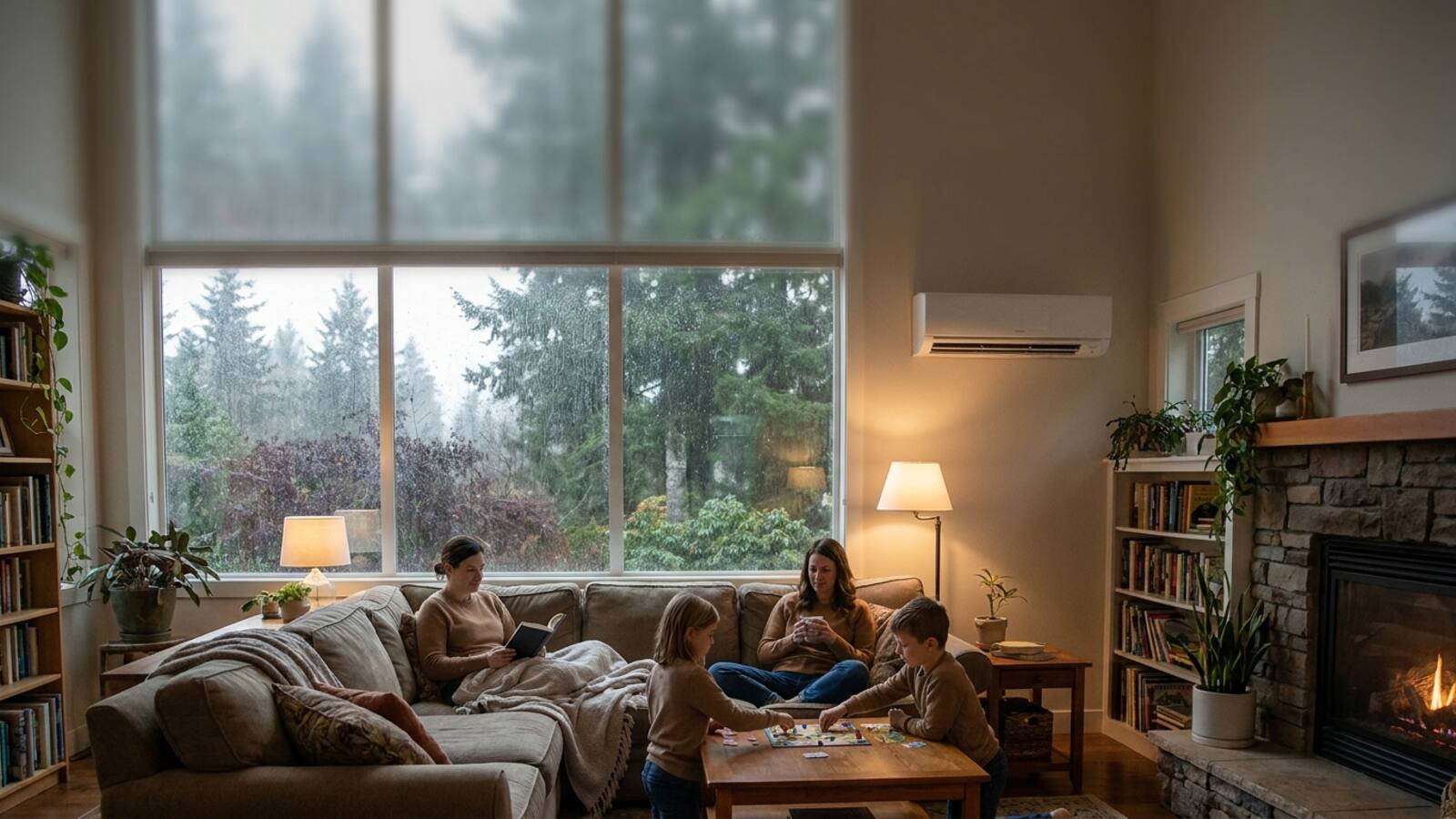
Western Washington rarely sees the triple-digit heat or the oppressive summer humidity that pushes homeowners in other parts of the country to run air conditioning hard. That's exactly why so many older homes here were built without any cooling system at all, and why plenty of homeowners still ask whether they even need one. But the marine climate that keeps temperatures mild also keeps relative humidity high for most of the year, commonly in the 75-85% range through fall, winter, and spring, driven by near-constant rain and cloud cover off the Sound.
That's the part that actually damages a home. It isn't a single brutal heat wave, it's months of chronic dampness: condensation forming on cold window glass, moisture soaking into crawlspace framing, closets on north-facing exterior walls staying just humid enough for mildew to take hold. A heat pump that runs efficiently in both directions, heating through the wet winter and cooling through the occasional warm stretch, ends up doing more for a Puget Sound home's humidity than its cooling capacity alone would suggest.
How Does a Heat Pump Actually Remove Moisture From the Air?
It's the same physics as a window air conditioner or a standalone dehumidifier. When a heat pump runs in cooling mode, refrigerant inside the indoor coil gets cold enough that it drops below the dew point of the air blowing across it. Water vapor in that air condenses on the coil fins into liquid water, which collects in a drain pan and exits through a condensate line. This happens automatically any time a ducted heat pump or ductless mini-split is actively cooling, whether or not anyone in the house is thinking about humidity at all.
Heating mode doesn't work the same way. Warming the air doesn't pull moisture out of it, so a heat pump running in heat mode through a damp Puget Sound winter isn't drying the air the way it does in summer. That's part of why ventilation and moisture control at the source, covered further down, still matter through the wetter months.
What's the Difference Between Cool Mode and a Mini-Split's Dry Mode?
Cool mode is built to hit a temperature target. The compressor and fan run at whatever speed gets the room to the thermostat setpoint fastest, and moisture removal is a side effect of that process, not the goal. Dry mode, sometimes labeled dehumidify mode, flips the priority. It is standard on the Mitsubishi, Daikin, and Hitachi ductless systems Varsity installs. The indoor fan slows way down so air lingers longer on the cold coil, condensing more moisture per cubic foot of airflow, while the room's temperature barely moves.
That distinction matters on a specific kind of Puget Sound day: 65-70°F and muggy, spring or fall, the kind of afternoon where Cool mode would chill the room uncomfortably before it did much for the dampness. Dry mode is the setting built for exactly that.
| Mode / System | What It Prioritizes | Best For | Effect on Temperature |
|---|---|---|---|
| Cool Mode | Reaching the thermostat setpoint | Warm afternoons | Noticeable drop; humidity falls as a side effect |
| Dry Mode (mini-split) | Pulling moisture out of the air | Damp, mild spring/fall days | Minimal drop; slow fan speed |
| Two-stage / variable-speed ducted heat pump | Long, low-capacity run times | Whole-home comfort year-round | Steady; more total moisture removed than single-stage |
| Standalone dehumidifier | Moisture removal only | Crawlspaces, basements, unconditioned rooms | None |
Can an Oversized Heat Pump Actually Make a Room Feel More Humid?
Yes, and it's one of the more counterintuitive problems in HVAC sizing. An oversized single-stage system satisfies the thermostat's temperature call quickly, then shuts off, a pattern called short-cycling, before it's run long enough to condense much moisture off the coil. The thermostat reads cool. The room still feels clammy. It's a mismatch between what the temperature sensor measures and what actually makes a space feel comfortable.
A correctly sized system avoids that trap, and a two-stage or variable-speed compressor avoids it further still, since it can run a longer, lower-capacity cycle instead of blasting full output and shutting off. That's the same reasoning behind why Varsity's higher equipment tiers, built around two-stage and variable-speed compressors, deliver noticeably better dehumidification than an entry-level single-stage system, independent of raw cooling capacity. Getting the sizing right starts with an actual load calculation, not a guess based on square footage, which is part of why we run one on every free estimate.
Not Sure Your Current System Is Sized Right?
Every Varsity estimate includes a real load calculation, not a square-footage guess — so the system you get actually matches your home's humidity and comfort needs.
Where Does Mold Actually Show Up in Puget Sound Homes?
Almost never in the middle of a well-ventilated living room. It shows up in the spots where moisture gets trapped and airflow doesn't reach: crawlspaces without a proper vapor barrier over exposed soil, bathrooms with an exhaust fan that vents into the attic instead of outside (which just relocates the moisture problem), closets built against a cold exterior wall where warm humid indoor air meets cold sheathing and condenses, and around older single-pane or aluminum-frame windows that sweat on a cold, damp morning.
A correctly sized heat pump helps with all of this indirectly, by keeping the home's overall relative humidity lower than it would otherwise run. It can't fix a structural moisture source by itself. A leaking crawlspace vent, a bath fan dumping into the attic, or a window that's condensing every winter morning needs to be addressed directly, not conditioned around.
Does a Heat Pump Replace the Need for Ventilation?
No, and this is worth being straight about. A heat pump conditions and, in cooling mode, somewhat dries the air that passes through its coil, but it doesn't bring in fresh outdoor air and it doesn't exhaust moisture at the source the way a bathroom fan or a range hood does. Washington's energy code requires mechanical whole-house ventilation, a continuous exhaust fan or heat-recovery ventilator, in new construction specifically because tightly built modern homes trap cooking, shower, and laundry moisture indoors instead of letting it escape naturally the way a drafty older house would.
The two systems do different jobs and work best together: exhaust fans and ventilation remove moisture at the source, and a properly sized heat pump manages the humidity and temperature of the air that's left. Neither one is a substitute for the other.
How Should a System Be Sized for Better Humidity Control?
It starts with a real load calculation for the specific home, not a rule of thumb based on square footage, since an oversized system is what causes the short-cycling and clamminess covered above. From there, equipment tier matters: Varsity's Good, Better, and Best options span single-stage through variable-speed compressors, and the higher tiers run longer, gentler cycles that pull more total moisture out of the air over a day, not just more BTUs of cooling. For homes with rooms that run noticeably more humid than others, a bonus room over a garage, a sunroom, an addition, ductless zoning with a dedicated mini-split head and its own Dry mode can control that one space without over-conditioning the rest of the house.
If you're trying to figure out what your specific home needs, whether that's confirming your current system is even sized correctly or comparing a ducted heat pump against a mini-split for a problem room, a free estimate includes an actual load calculation, not a guess. We run estimates and installs Monday through Friday, 8:00 AM to 6:00 PM, and every installation carries a 10-year parts and labor warranty. Call (253) 785-4622 or request a quote online.
Heat Pump Humidity FAQs
Largely, yes, when a heat pump is running in cooling mode. The indoor coil gets colder than the dew point of the air passing over it, water vapor condenses on the coil fins, and it drains away through a condensate line, the same physics a standalone dehumidifier or a window AC uses. This happens automatically anytime a ducted heat pump or ductless mini-split is cooling, whether or not anyone is thinking about humidity at all.
Dry mode, sometimes labeled dehumidify mode, is available on most ductless mini-split heads, including the Mitsubishi, Daikin, and Hitachi systems Varsity installs. Instead of prioritizing temperature the way Cool mode does, Dry mode slows the indoor fan way down so air lingers longer on the cold coil, pulling out more moisture with only a small temperature drop. It's the setting to reach for on a muggy 65-70°F Puget Sound day, spring or fall, when the room feels clammy but running full air conditioning would make it uncomfortably cold.
Yes. An oversized single-stage system satisfies the thermostat's temperature call quickly and shuts off, a pattern called short-cycling, before it's run long enough to pull much moisture out of the air. The thermostat reads cool, but the room still feels damp. A correctly sized system, especially a two-stage or variable-speed compressor, runs longer and gentler cycles and removes noticeably more total moisture over the course of a day.
A correctly sized heat pump helps by keeping overall indoor relative humidity down, which makes conditions less favorable for mold. It cannot fix a structural moisture source on its own, though, like a crawlspace without a vapor barrier, a bathroom fan that vents into the attic instead of outside, or condensation on old single-pane windows. Those need to be addressed directly. The heat pump manages the air; it doesn't replace ventilation or moisture control at the source.
Yes. A heat pump conditions and somewhat dries the air that passes through its coil, but it doesn't bring in fresh outdoor air or exhaust moisture at the source the way a bathroom fan or range hood does. Washington's energy code requires mechanical whole-house ventilation in new construction for this reason, since tightly built homes trap cooking, shower, and laundry moisture indoors. Exhaust fans vented to the exterior and a heat pump work together; neither one covers for the other.