
Heat Pump Repair & Replacement in Tacoma, WA
Expert diagnostics and repair for all heat pump brands serving Stadium District, North End/Proctor, Hilltop, and all of Tacoma. When repair isn't the answer, we provide honest replacement recommendations with a 10-year warranty. Served by Tacoma Power, not the utility most rebate articles assume.
Your Tacoma Heat Pump Repair Team
Tacoma homeowners in Stadium District, North End/Proctor, and Hilltop rely on their heat pumps year-round — for heating from October through April, cooling from June through September, and shoulder seasons in between. When something stops working, you need a fast diagnosis and a straight answer.
You are a Tacoma Power customer, which means the rebate tables written for the rest of the region are irrelevant to you and Tacoma Power's 0% $20,000 loan — which almost nobody mentions — probably is not. Tacoma Power pays only through Participating Contractors, so who does the work decides whether the money ever shows up.
The Washington State Energy Code lists Tacoma at a 29°F winter design temperature (WAC 51-11C-80100, Table C-1). That is the number a Manual J load calculation for your home is run against, and it is the difference between equipment that carries the house on its own and equipment that leans on expensive backup heat every cold snap. Natural gas here comes from the local gas utility. In Tacoma we most often find oil and gravity furnaces still running in North End and Stadium District homes, gas forced air across the mid-century South End, and electric wall heat in un-ducted bungalows — so we quote what your house actually has, not what the average Puget Sound home has.
Heat Pump Services for Tacoma Homes
Why Tacoma Homeowners Choose Us
Fast Response
Based in Federal Way, we reach Tacoma quickly for heat pump diagnostics. Most repairs are completed same-day, and full replacements are scheduled within 1-2 days when equipment is in stock.
Know Local Codes
The mechanical permit for your heat pump is issued by the City of Tacoma Planning & Development Services Department. We pull it, pay the fee, book the inspection and meet the inspector on site. Exterior work in Tacoma may also go before the Tacoma Landmarks Preservation Commission, which reviews exterior changes — including condenser placement and lineset routing — on registered properties across the city's historic districts.
Understand Local Homes
In Tacoma we usually find oil and gravity furnaces still running in North End and Stadium District homes, gas forced air across the mid-century South End, and electric wall heat in un-ducted bungalows. We size to your house at the 29°F design temperature the state energy code sets for this area — not to a rule of thumb. Near Commencement Bay, Ruston Way and Point Defiance we specify corrosion-rated coils.
Common Heat Pump Issues in Tacoma
Who bills you for power decides what you can claim. Tacoma is served by Tacoma Power. That means $2,000 for a variable-speed heat pump replacing zonal or electric forced air, $1,000 for a standard air-source or ductless system, and — the part most homeowners miss — a 0% interest loan of up to $20,000 over seven years. Income-qualified households can defer the loan entirely and owe nothing until the home sells. Tacoma Power pays only through a Participating Contractor, and only on equipment rated at least HSPF2 7.5 / SEER2 14.3, on a home that is not new construction and has not taken a Tacoma Power heat pump incentive before.
Tacoma does not share Seattle's weather, and the code says so. The Washington State Energy Code lists Tacoma at a 29°F winter design temperature (WAC 51-11C-80100, Table C-1). That is the number a Manual J load calculation for your home is run against, and it is the difference between equipment that carries the house on its own and equipment that leans on expensive backup heat every cold snap. Federal Way is 24°F — a real gap for towns this close together. Tacoma is the milder side of that line, and equipment sized for the colder neighbor is equipment you paid too much for.
What we expect to find in a Tacoma home. The local stock runs to Victorian mansions in Stadium District, Craftsman bungalows on the North Slope, American Foursquares, Tudor Revivals, and Queen Anne styles across nine historic districts. That usually means oil and gravity furnaces still running in North End and Stadium District homes, gas forced air across the mid-century South End, and electric wall heat in un-ducted bungalows. Gas service here comes from the local gas utility. Whether repairing or replacing a heat pump is the right answer for your house is something we tell you after we look at it, not before.
The parts of the job that are specific to this address. In Tacoma, the mechanical permit is issued by the City of Tacoma Planning & Development Services Department, and we pull it, pay it and meet the inspector; exterior work may go before the Tacoma Landmarks Preservation Commission, which reviews exterior changes — including condenser placement and lineset routing — on registered properties across the city's historic districts, so where the outdoor unit sits is a permitting decision here, not just an aesthetic one; homes near Commencement Bay, Ruston Way and Point Defiance get corrosion-rated coil coatings and a twice-yearly coil rinse instead of annual service — salt air is what kills condensers early on this shoreline; burn bans and wildfire-smoke advisories here are called by Puget Sound Clean Air Agency, which is the season that makes filtration worth specifying properly.
Quick Facts
Local details that change a heat pump job in Tacoma
Tacoma is not on the utility most heat pump rebate advice on the internet assumes, which quietly invalidates it. The facts below are the ones that actually apply to your meter.
- Electric utility
- Tacoma Power
- Natural gas
- the local gas utility
- Winter design temp
- 29°F WSEC Table C-1, WAC 51-11C-80100
- Mechanical permit
- City of Tacoma Planning & Development Services Department
- Rebate program that applies
- Tacoma Power
- Burn bans & smoke advisories
- Puget Sound Clean Air Agency
- Heat we usually find
- oil and gravity furnaces still running in North End and Stadium District homes, gas forced air across the mid-century South End, and electric wall heat in un-ducted bungalows
- Salt-air exposure
- Commencement Bay, Ruston Way and Point Defiance — corrosion-rated equipment recommended
- Design / historic review
- the Tacoma Landmarks Preservation Commission, which reviews exterior changes — including condenser placement and lineset routing — on registered properties across the city's historic districts
“The service was fast, the team was competent and not overly salesy. Rapid response and same-day repair of our heat pump.”
— Scott D., Federal Way, WA
Heat Pump Questions from Tacoma Homeowners
Heat pump repairs in Tacoma range from $150 for a basic capacitor replacement to $1,500+ for major component repairs (compressor, refrigerant leak repair with significant recharge, defrost board replacement). Most common repairs — capacitors, contactors, sensors — fall in the $150-$500 range. Full replacements run from $10,000 to $16,000 depending on equipment tier and scope. We provide written quotes before any repair work begins.
Yes. The mechanical permit is issued by the City of Tacoma Planning & Development Services Department, and Washington State requires one for this work. We handle the whole thing — application, fee, and meeting the inspector for the final — so you never contact the permit desk yourself. In Tacoma, exterior equipment may additionally need sign-off from the Tacoma Landmarks Preservation Commission, which reviews exterior changes — including condenser placement and lineset routing — on registered properties across the city's historic districts, which we factor into placement before we quote. Every install meets or exceeds the current Washington State mechanical and energy codes.
Most heat pump repairs in Tacoma are completed same-day, often within an hour or two of arrival. We carry common failure parts (capacitors, contactors, common sensors) on the truck. Repairs requiring special-order parts (specific control boards, specific compressors) typically take 2-5 days for parts arrival. Full system replacements run 1-2 days.
Use the 50% rule and the age rule. If the repair quote exceeds 50% of replacement cost, replace. If the unit is 12+ years old AND the failure is a major component (compressor, evaporator coil, condenser coil), replace. If the unit uses R-22 (Freon) refrigerant, replace — R-22 is phased out and refilling it is expensive and impractical. Below those thresholds, repair almost always wins.
Varsity Heating and Cooling services every major heat pump brand sold in Tacoma: Day & Night, Carrier, Mitsubishi, American Standard, Daikin, Trane, Lennox, Rheem, Goodman, and others. We install Day & Night, Carrier, Mitsubishi, American Standard, and Daikin as our primary replacement brands — selected for Tacoma-climate reliability and strong manufacturer support.
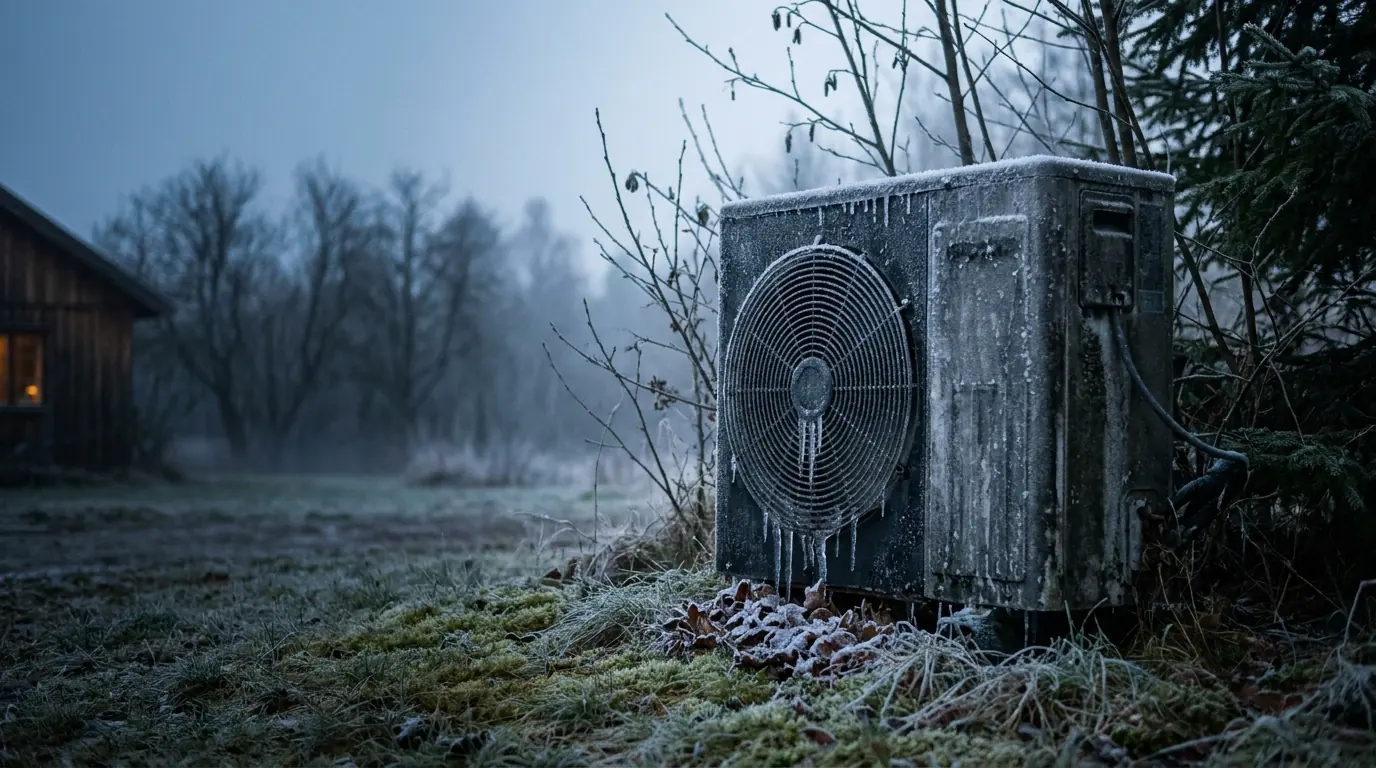
Some ice on the outdoor coil during Tacoma's damp winter weather is normal — heat pumps run a defrost cycle every 30-90 minutes to clear it. Constant heavy icing usually points to: a failed defrost board or sensor, low refrigerant charge, restricted airflow (blocked outdoor coil, dirty filter), or a stuck reversing valve. Don't pour hot water on it — that can crack the coil. Call us for a diagnostic.
The Washington State Energy Code lists Tacoma at a 29°F winter design temperature (WAC 51-11C-80100, Table C-1). That is the number a Manual J load calculation for your home is run against, and it is the difference between equipment that carries the house on its own and equipment that leans on expensive backup heat every cold snap. A cold-climate heat pump holds its rated capacity well below that, which is why heat pumps genuinely work here rather than being a compromise. Gas here comes from the local gas utility, and for some homes a hybrid — heat pump for most of the year, gas furnace for the coldest mornings — is the right answer. We will tell you if it is.
Heat Pump Repair Near Tacoma
Heat Pump Not Working in Tacoma?
Same-day diagnostics, honest repair-vs-replace recommendations, and 10-year warranties on every installation.