
How Much Does a Heat Pump Cost in Kent in 2026?
Kent has grown fast — from agricultural roots to Washington's sixth-largest city — and the housing that came with that growth is genuinely mixed, which is why "how much does a heat pump cost" doesn't have one flat answer here the way it might in a more uniform suburb. Here's what heat pump installation in Kent actually costs in 2026, based on what we quote and install across the city:
| System Type | Installed Price (Kent, 2026) |
|---|---|
| Ducted heat pump (whole home, uses existing ductwork) | $12,000 – $18,000 |
| Ductless mini-split (single or multi-zone, no ducts needed) | $8,000 – $14,000 |
| Heat pump replacement (swapping an existing system) | $10,000 – $16,000 |
| Ductwork repair or modification (if your ducts need help) | $3,000 – $8,000 |
| Repair (existing system, not replacement) | $150 – $1,500 |
Those ranges shift with equipment tier. Every Kent quote comes in Good, Better, and Best options — Good is a solid, efficient system that gets the job done, Best buys higher efficiency, quieter operation, and stronger cold-snap performance. You pick the tier before work starts, and the number you sign is the number you pay. For how Kent compares to the wider region, see our Washington heat pump cost guide.
Why Kent's Mixed Housing Stock Changes the Number
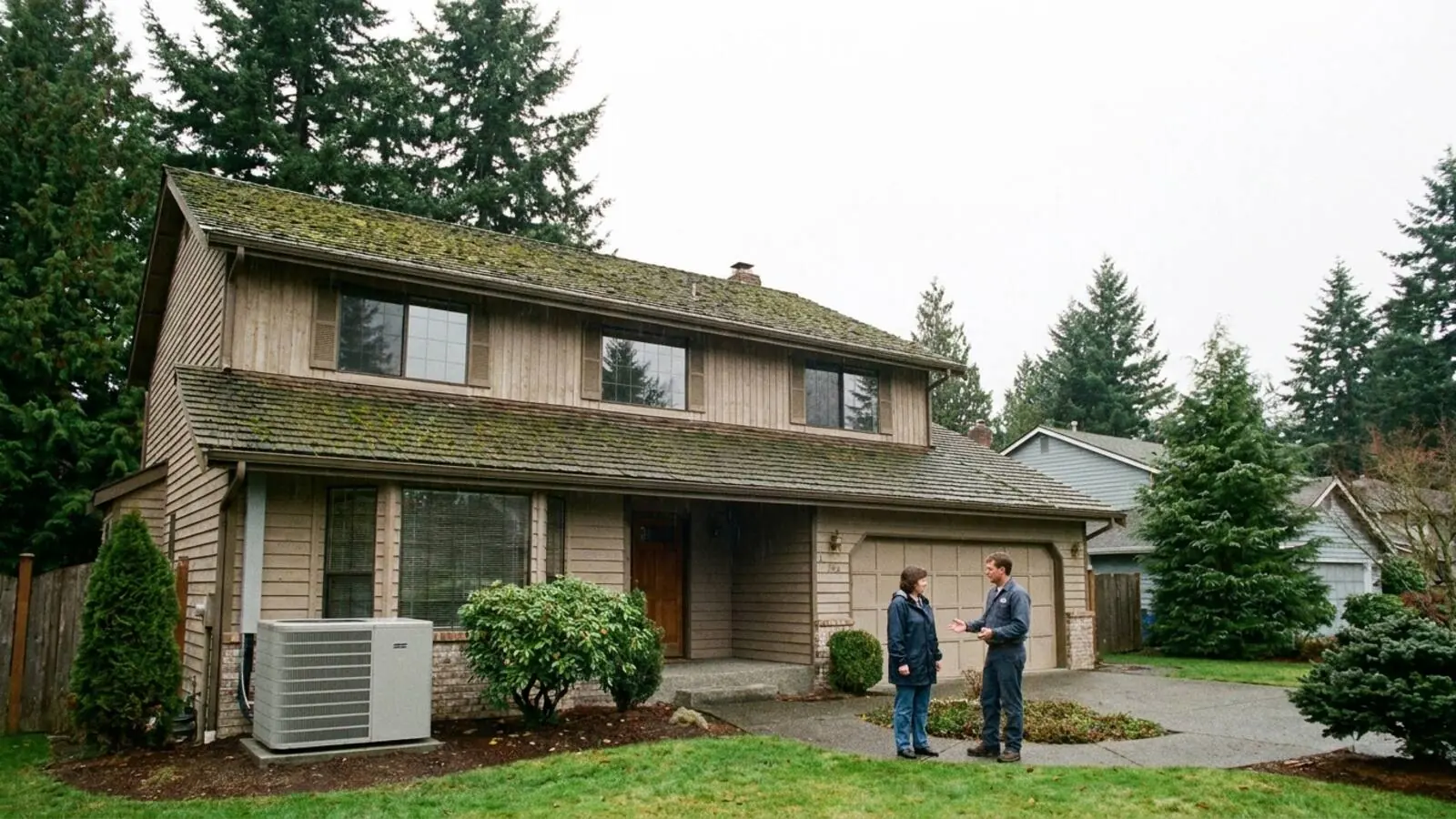
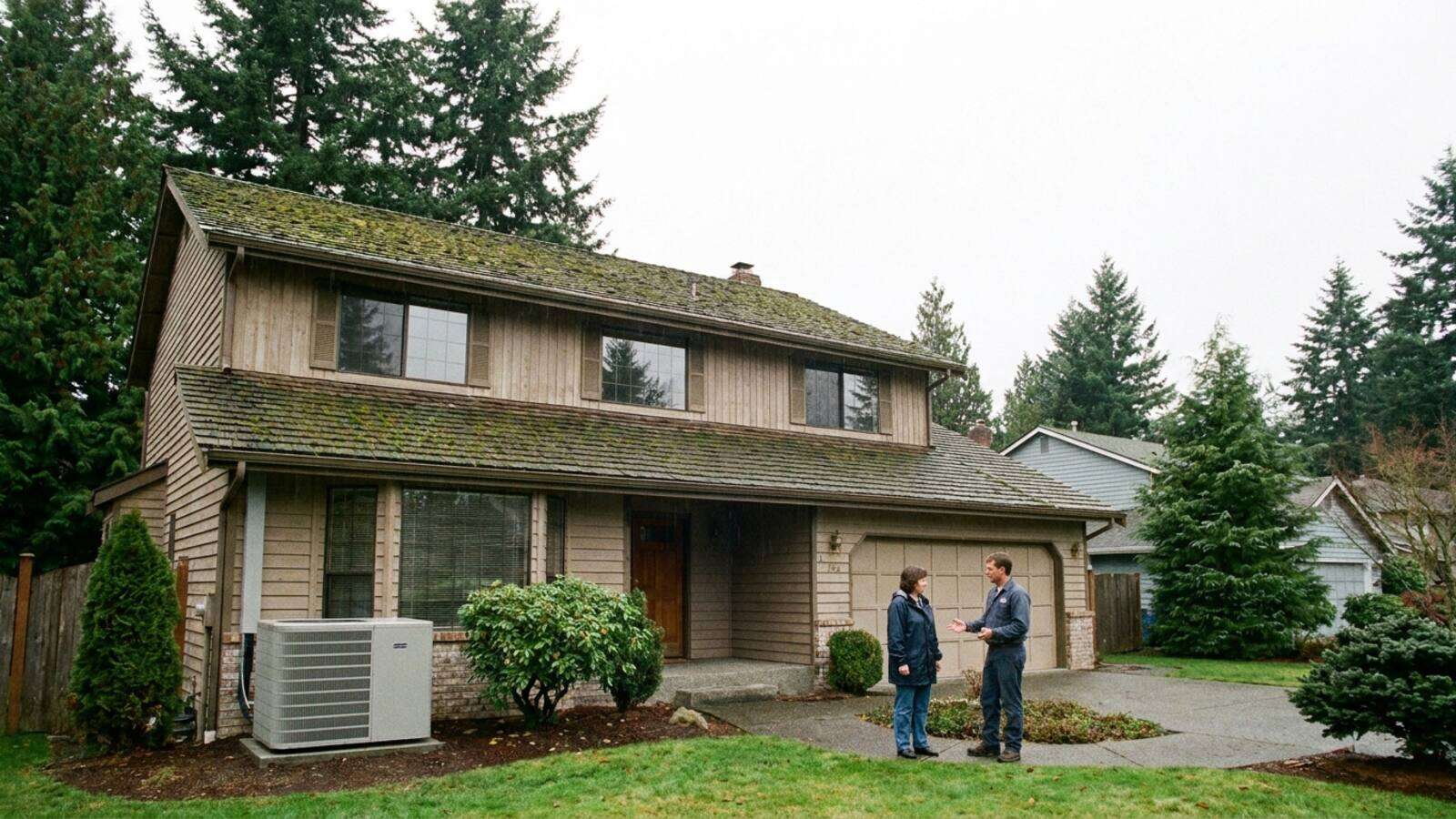
On East Hill, split-levels and ramblers from the 1960s through the 1980s dominate the residential streets, most still on their second or third furnace since being built. That's the straightforward case for a heat pump: the new outdoor unit connects to ductwork that's already there, heats and cools the whole house, and skips the wall-opening, ceiling-cutting work a mini-split conversion would need. Most of what we install on East Hill and West Hill falls into the $12,000–$18,000 ducted lane.
Kent's agricultural heritage left another pocket of housing that changes the math: manufactured homes, still common in parts of the city. These typically run smaller, sealed duct systems built for one specific furnace, and not every ducted heat pump is rated to pair with that setup. Some manufactured homes are a clean ducted swap once we've checked the equipment; others are a genuinely better fit for a ductless mini-split, which sidesteps the ductwork compatibility question entirely and lands in the $8,000–$14,000 range.
Kent's newer suburban developments and townhome infill — concentrated around Scenic Hill and Meridian — were built with central air from day one, and those installs are usually the most predictable of the three: existing ductwork sized correctly for the home, no compatibility guesswork, typically landing mid-range in the ducted band rather than at the top.
Across all three, "has ductwork" isn't the same as "reuse the ductwork as-is." Some of Kent's older East Hill split-levels have ducts sized for a smaller furnace than the heat pump they'd be paired with, or runs that were never sealed well to begin with. We inspect the existing ductwork as part of every estimate rather than assuming it's fine, because a heat pump pushing air through undersized or leaky ducts underperforms no matter how good the outdoor unit is. When ducts need help, that's the $3,000–$8,000 repair or modification line above — usually cheaper than it sounds, and far cheaper than living with a system that never quite keeps up.
Want Your Real Kent Number?
Skip the generic ranges. Tell us about your home — East Hill split-level, West Hill rambler, or something newer — and get a genuine estimate in about 60 seconds.
Which Heat Pump Rebates Actually Apply in Kent?
Kent sits in a single utility's service territory for both gas and electric, the same program structure used across most of King County — no utility-boundary guessing game to untangle before we can tell you what applies to your address.
Local utility rebates can pay for converting an existing electric-resistance system — baseboards, wall heaters — to a qualifying heat pump. Income-qualified gas conversions can be worth more, and the exact amount depends on what you're replacing and the equipment you install. Two things worth knowing for 2026: the federal 25C tax credit ended December 31, 2025, so no 2026 installation qualifies for it regardless of what a salesperson claims, and utility rebate programs pay only through their own contractor networks, with rules that change — so we confirm the current requirements before quoting rather than after. We verify your specific numbers and file the paperwork rather than quoting a rebate off memory. Our local utility rebate guide covers the full program breakdown.
Do Older East Hill and West Hill Homes Need Electrical Work First?
Most don't. The majority of Kent's 1960s–1980s split-levels and ramblers on East Hill and West Hill have panels with enough spare capacity for a heat pump circuit without any upgrade. A smaller number of the oldest homes, particularly some of the earliest tracts, still run on 100-amp service or original wiring that's worth a second look before new equipment goes in.
This isn't a reason to expect a surprise bill. It's a line item we check during the free estimate — we tell you plainly whether your panel is fine or needs attention, and we price it up front, so the number you sign is the number you pay.
Does Kent's Climate Actually Favor Heat Pumps?
Yes, and it's not close. Kent sits in the same mild Puget Sound marine climate that makes this one of the best regions in the country for heat pumps — winters are mild, with temperatures rarely dropping below 25°F. That's exactly the range where modern heat pumps run at their highest efficiency. The cold-snap horror stories that make people nervous about heat pumps come from places with real winters; Western Washington isn't one of them.
The payoff runs in both directions. Homeowners converting from electric baseboard or wall heaters typically cut heating costs 30% to 50%. In summer, the same outdoor unit runs in reverse and cools the house — which matters more every year, especially in East Hill and West Hill homes built decades ago with heating in mind and no air conditioning at all. One system handles both jobs on one maintenance schedule, which is part of why a heat pump usually pencils out better over 15 years than a furnace-plus-AC combo even when the upfront number looks similar.
What Does Installation Day Look Like in Kent?
Here's how a typical Kent install goes with our crew:
- Load calculation, not a square-footage guess. A 1970s split-level on East Hill and a newer townhome near Kent Station need different equipment even at similar square footage.
- A real quote in Good, Better, Best tiers — with your utility rebate eligibility verified for your address, not assumed.
- Permits handled. We pull the required City of Kent mechanical permit as part of every job.
- Most installs done in one day. Straightforward ducted swaps and single-zone mini-splits are typically morning-to-evening.
- A 10-year parts AND labor warranty on every installation, not just manufacturer coverage on parts.
Budget $12,000–$18,000 for a ducted system or $8,000–$14,000 for mini-splits, get more than one quote, and compare load calcs, permits, and warranties — not just the bottom line. Call (253) 785-4622 or get a free estimate to see your real number.
Kent Heat Pump Cost FAQs
Most Kent homes pay $12,000 to $18,000 installed for a ducted heat pump or $8,000 to $14,000 for ductless mini-splits in 2026. Replacing an existing heat pump runs $10,000 to $16,000. The final number depends on your home's size, whether it has usable ductwork, and the equipment tier you choose (Good, Better, Best).
Kent sits in a single utility's service territory for both gas and electric, the same program structure used across most of King County. Local utility rebates can pay for converting an existing electric-resistance system to a qualifying heat pump, and income-qualified gas conversions can be worth more, with the exact amount depending on what's being replaced and the equipment installed. The federal 25C tax credit ended December 31, 2025. Programs change, so we confirm what your utility actually pays and handle the paperwork.
Often yes. Manufactured homes in parts of Kent typically run smaller, sealed duct systems built for a specific furnace, and not every ducted heat pump is rated to pair with that setup. We check the existing equipment and ductwork before recommending a system — some manufactured homes are a clean ducted swap, and others are a better fit for a mini-split that skips the ductwork question entirely.
Some do. Most of Kent's 1960s-1980s split-levels and ramblers on East Hill and West Hill have enough panel capacity for a heat pump without an upgrade. A smaller number of the oldest homes still run on 100-amp service or original wiring that's worth checking before new equipment goes in. It's a line item we verify during the free estimate, not a surprise on installation day.
Most Varsity Heating installations in Kent are completed in one day. Every installation includes a load calculation, the required City of Kent mechanical permit, and a 10-year parts and labor warranty.