How Much Does a Heat Pump Cost in Federal Way in 2026?
We get asked this more in Federal Way than anywhere else we work, for an obvious reason — it's where Varsity Heating and Cooling is based. Our office sits at 1112 S 344th St, so these aren't secondhand numbers pulled from a regional average. They're what we actually quote and install for neighbors down the street. Here are the real installed ranges for 2026:
| System Type | Installed Price (Federal Way, 2026) |
|---|---|
| Ducted heat pump (whole home, uses existing ductwork) | $12,000 – $18,000 |
| Ductless mini-split (single or multi-zone, no ducts needed) | $8,000 – $14,000 |
| Heat pump replacement (swapping an existing system) | $10,000 – $16,000 |
| Ductwork repair or modification (if your ducts need help) | $3,000 – $8,000 |
| Repair (existing system, not replacement) | $150 – $1,500 |
Those ranges move based on equipment tier. Every Federal Way quote comes in Good, Better, and Best options — Good is a solid, efficient system that gets the job done, Best buys higher efficiency, quieter operation, and stronger cold-snap performance. You choose the tier, and there's no bait-and-switch once the crew is on site. For how Federal Way compares to the rest of the region, see our Washington heat pump cost guide.
Why Does Federal Way's Housing Stock Keep This Simple?
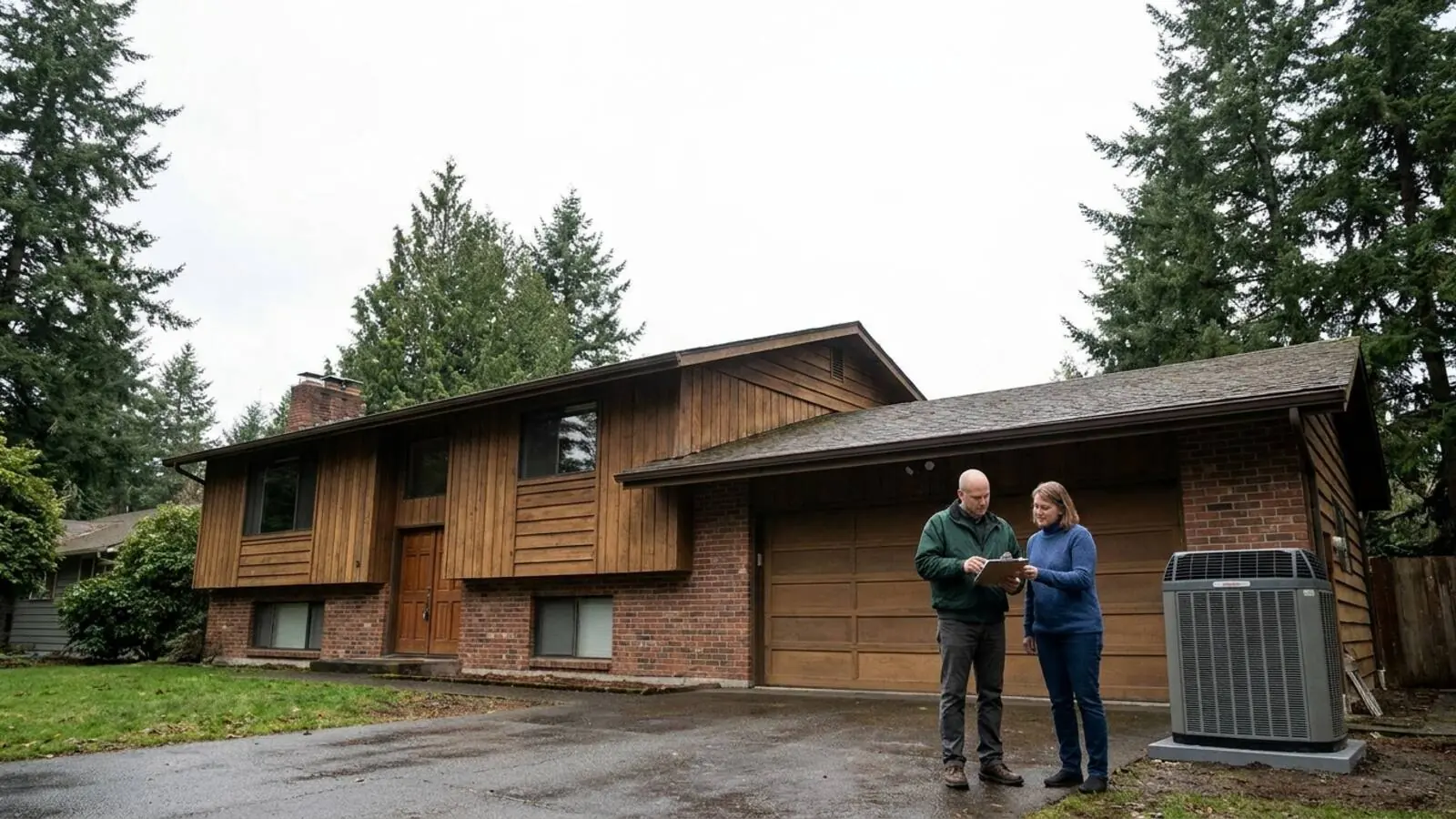
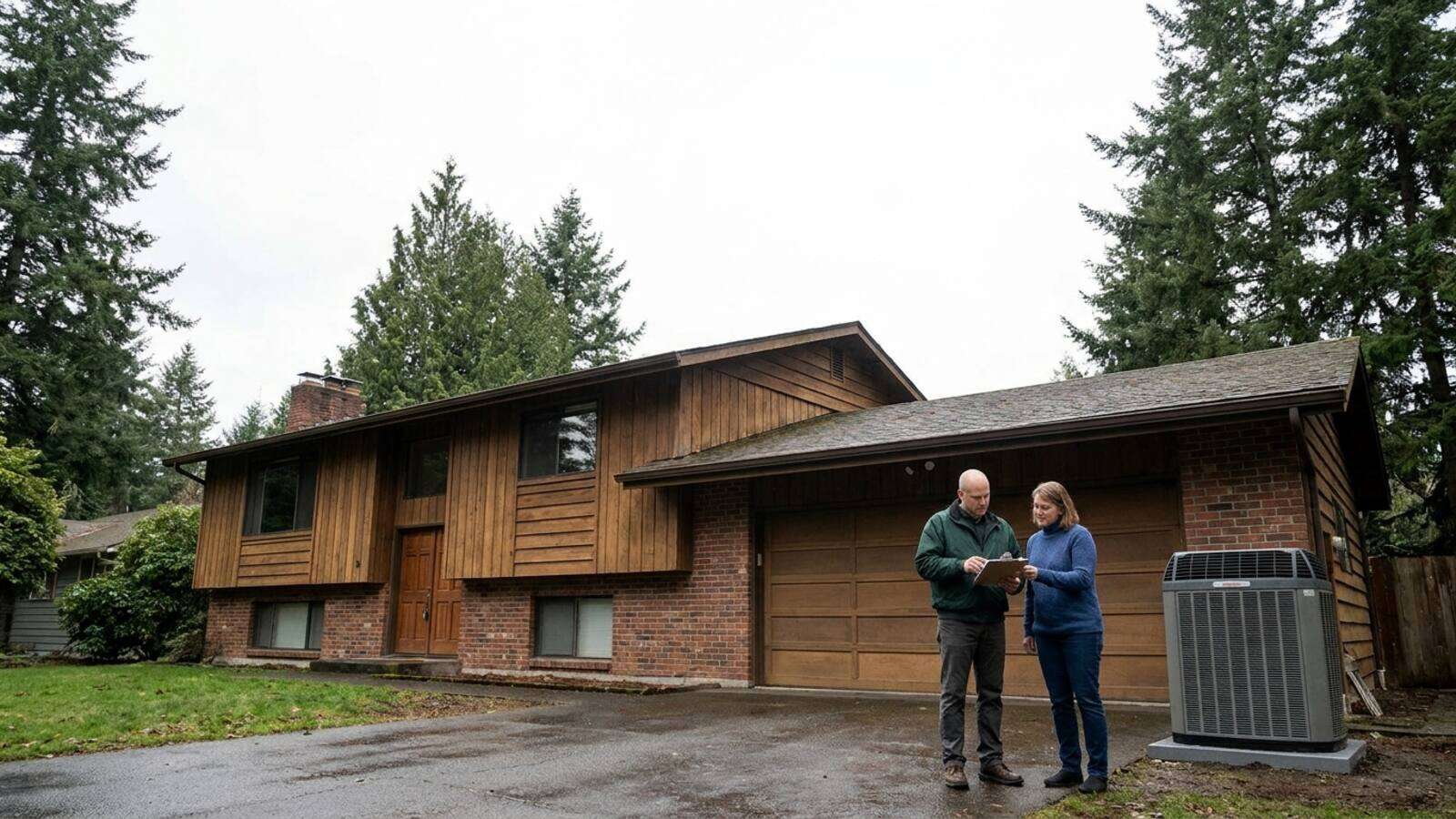
Federal Way's housing is dominated by 1970s–1990s ramblers and split-levels across neighborhoods like Twin Lakes, Mirror Lake, and Steel Lake — classic suburban tract housing built with forced-air furnaces and full ductwork already in place. That's the easy case for a heat pump: the new outdoor unit connects to your existing ducts and vents, heats and cools the whole house, and doesn't require opening up walls or ceilings. Most of what we install in Federal Way falls into this $12,000–$18,000 ducted lane.
Two other pockets of Federal Way housing change the math. Older homes still running electric baseboard heat — common in some of the city's earlier tracts — are the classic case for a ductless mini-split conversion, since there's no ductwork to reuse and mini-splits skip that problem entirely. And the newer townhome and condo developments that have filled in around the city in the last decade were built with central air from day one, which usually means a straightforward install that lands mid-range rather than at the top of the ducted price band.
That said, "has ductwork" doesn't automatically mean "reuse the ductwork." Some Twin Lakes and Mirror Lake ramblers from the earlier end of that build window have ducts sized for a smaller furnace than the heat pump we'd be pairing them with, or runs that were never sealed well to begin with. We inspect the existing ductwork as part of every estimate rather than assuming it's fine, because a heat pump forced to push air through undersized or leaky ducts underperforms no matter how good the outdoor unit is. When ducts need help, that's the $3,000–$8,000 repair or modification line in the table above — usually cheaper than it sounds, and far cheaper than living with a system that never quite keeps up.
What Do Dash Point and Redondo Waterfront Homes Need Differently?
Federal Way has real Puget Sound waterfront — Dash Point and Redondo sit right on the water, and that changes one thing about the installation: salt air. An outdoor heat pump unit near the shoreline corrodes faster than the same unit five miles inland, and a coastal address deserves a contractor who plans for that instead of installing the same equipment everywhere.
For Dash Point and Redondo installs, we place the outdoor unit away from direct salt spray wherever the site allows, and we can spec coated coils built to resist corrosion for waterfront addresses. It's a placement and equipment-spec decision, not a different price bracket — the $12,000–$18,000 ducted range and $8,000–$14,000 mini-split range still apply, but a coastal install done right lasts noticeably longer than one that isn't.
The other thing waterfront lots sometimes bring is a tighter side yard or a view a homeowner doesn't want blocked by an outdoor condenser. We plan pad placement during the site visit with both concerns in mind — enough clearance for airflow and service access, and a spot that doesn't sit in the middle of a sightline to the water. It's a five-minute conversation during the estimate that saves a homeowner from staring at their new equipment every time they look out the kitchen window.
Which Heat Pump Rebates Actually Apply in Federal Way?
Here's a piece of good news specific to Federal Way: unlike some neighboring cities split between multiple electric utilities, Federal Way sits in a single utility's service territory for both gas and electric. There's no utility-boundary guessing game to untangle before we can tell you what applies.
Local utility rebates can pay for converting an existing electric-resistance system — baseboards, wall heaters — to a qualifying heat pump. Income-qualified gas conversions can be worth more, and the exact amount depends on what you're replacing and the equipment you install. Two things worth knowing for 2026: the federal 25C tax credit ended December 31, 2025, so no 2026 installation qualifies for it regardless of what a salesperson claims, and utility rebate programs pay only through their own contractor networks, with rules that change — so we confirm the current requirements before quoting rather than after. We verify your specific numbers and file the paperwork rather than quoting a rebate off memory. Our local utility rebate guide covers the full program breakdown.
Want Your Real Federal Way Number?
Skip the generic ranges. Tell us about your home and get a genuine estimate in about 60 seconds — including which local utility rebate programs apply to your address.
Do Older Federal Way Homes Need Electrical Work First?
Most don't. The majority of Federal Way's 1970s–1990s ramblers and split-levels have panels with enough spare capacity for a heat pump circuit without any upgrade. A smaller number of older homes, particularly some of the earliest tracts near the city center, still run on 100-amp service or wiring that's worth a second look before new equipment goes in.
This isn't a reason to expect a surprise bill. It's a line item we check during the free estimate — we tell you plainly whether your panel is fine or needs attention, and we price it up front, so the number you sign is the number you pay.
Does Federal Way's Climate Actually Favor Heat Pumps?
Yes, and it's not close. Federal Way sits in one of the best heat pump climates in the country — our marine air keeps winters mild, with temperatures rarely dropping below 25°F. That's exactly the range where modern heat pumps run at their highest efficiency. The cold-snap horror stories that make people nervous about heat pumps come from places with real winters; Western Washington isn't one of them, and Federal Way, sitting close to the Sound, runs even milder than inland foothill communities like Enumclaw or Buckley.
The payoff runs in both directions. Homeowners converting from electric baseboard or wall heaters typically cut heating costs 30% to 50%. In summer, the same outdoor unit runs in reverse and cools the house — which matters more every year, especially in older ramblers that were built with heating in mind and never really planned for air conditioning. One system handles both jobs, on one maintenance schedule, which is part of why a heat pump usually pencils out better over 15 years than a furnace-plus-AC combo even when the upfront number looks similar.
What Does Installation Day Look Like With the Local Company?
Being headquartered in Federal Way isn't a marketing line for us — it means our crew isn't driving in from another county to service your home. Here's how a typical install goes:
- Load calculation, not a square-footage guess. We measure what your specific home needs. A 1985 rambler on Steel Lake and a new townhome off Pacific Highway need different equipment even at similar square footage.
- A real quote in Good, Better, Best tiers — with your utility rebate eligibility verified for your address, not assumed.
- Permits handled. We pull the required City of Federal Way mechanical permit as part of every job.
- Most installs done in one day. Straightforward ducted swaps and single-zone mini-splits are typically morning-to-evening.
- A 10-year parts AND labor warranty on every installation, not just manufacturer coverage on parts.
We're an owner-operated crew, and Federal Way is where most of our reviews come from. From a real one: "Very impressed with the work they did. No high pressure to buy a new unit. Appreciated their honesty about repair costs." — Gayle N., Federal Way. Budget $12,000–$18,000 for a ducted system or $8,000–$14,000 for mini-splits, get more than one quote, and compare load calcs, permits, and warranties — not just the bottom line. Call (253) 785-4622 or get a free estimate to see your real number.
Federal Way Heat Pump Cost FAQs
Most Federal Way homes pay $12,000 to $18,000 installed for a ducted heat pump or $8,000 to $14,000 for ductless mini-splits in 2026. Replacing an existing heat pump runs $10,000 to $16,000. The final number depends on your home's size, whether it has usable ductwork, and the equipment tier you choose (Good, Better, Best).
Federal Way sits in a single utility's service territory for both gas and electric, so there's no utility split to untangle like in some neighboring cities. Local utility rebates can pay for converting an existing electric-resistance system to a qualifying heat pump, and income-qualified gas conversions can be worth more, with the exact amount depending on what's being replaced and the equipment installed. The federal 25C tax credit ended December 31, 2025. Programs change, so we confirm what your utility actually pays and handle the paperwork.
Yes, mainly around equipment placement and corrosion protection. Federal Way's Puget Sound waterfront along Dash Point and Redondo exposes outdoor units to salt air, which accelerates coil and cabinet corrosion faster than an inland install a few miles away. We place units away from direct spray where the site allows and can spec coated coils for waterfront addresses, which extends equipment life without changing the base price much.
Some do. Federal Way's housing stock is dominated by 1970s-1990s ramblers and split-levels, and most of those have adequate panels for a heat pump. A smaller number of older homes still run on 100-amp service or wiring that deserves a look before new equipment goes in. It's a line item, not a crisis — we check your panel during the free estimate so the number you sign is the number you pay.
Most Varsity Heating installations are completed in one day. We're headquartered on S 344th St in Federal Way, so this isn't a drive-in service area for us — it's where our crew lives and works. Every installation includes a load calculation, permit handling, and a 10-year parts and labor warranty.