
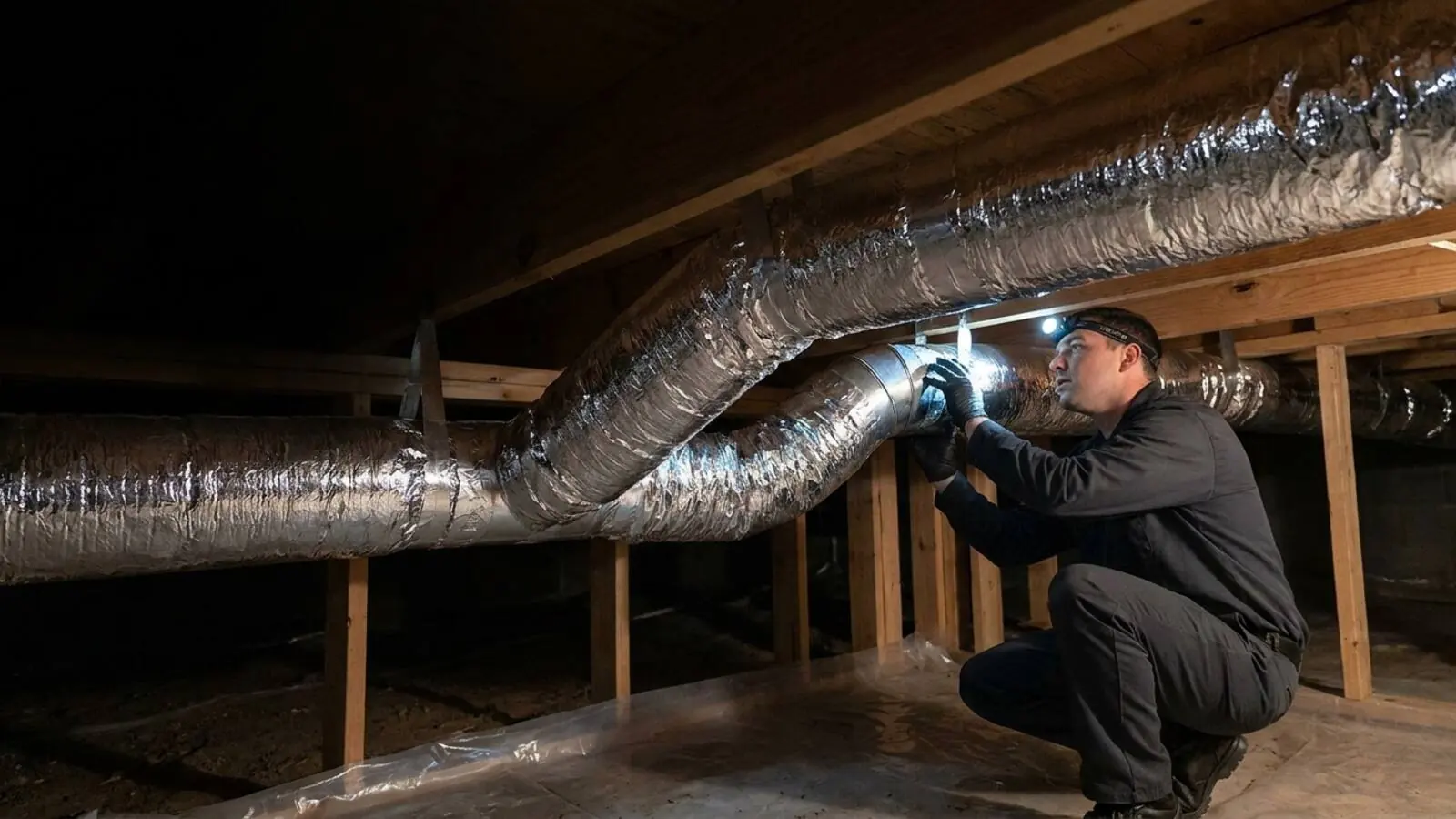
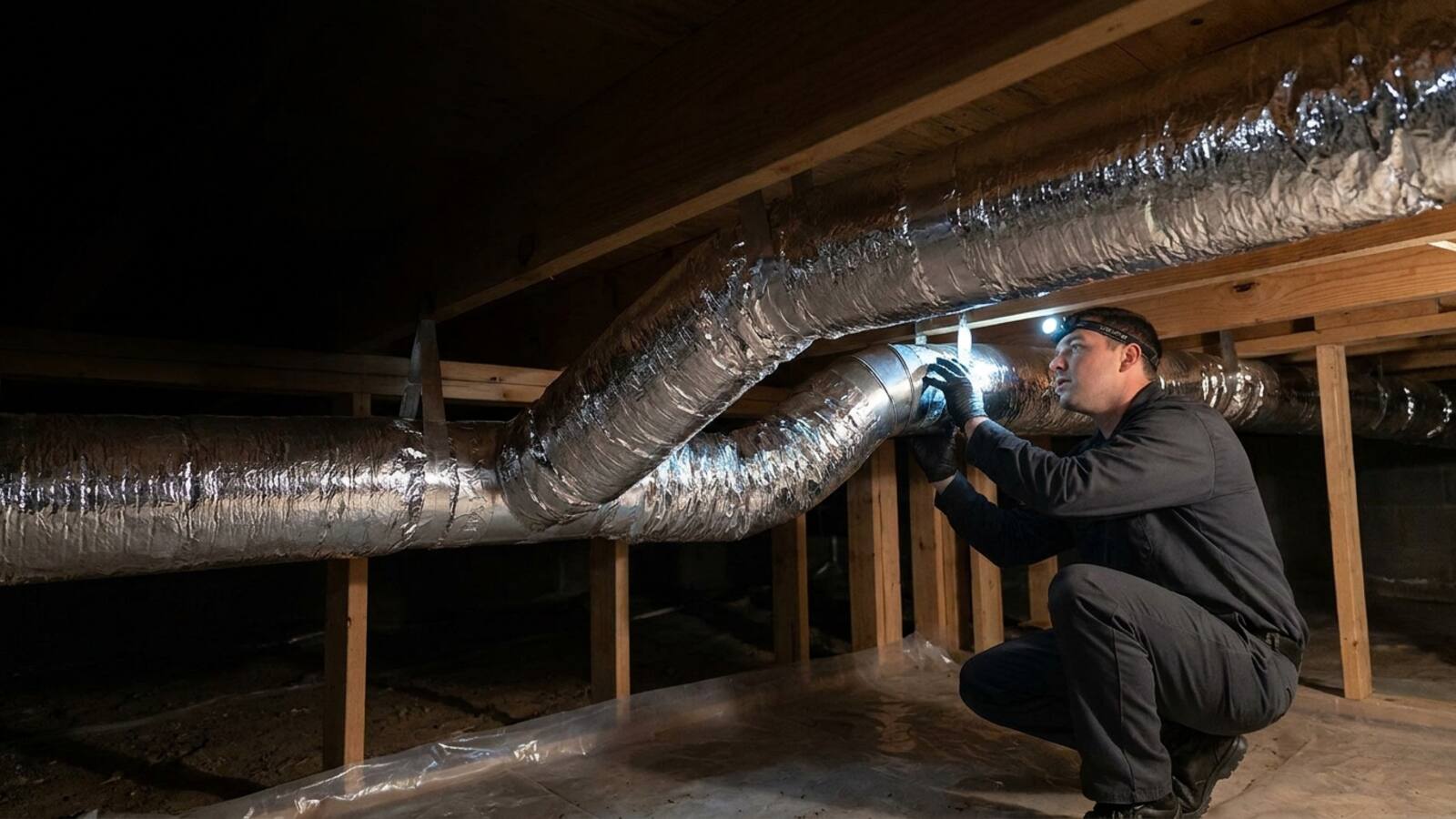
How Much Does Ductwork Replacement Cost in Washington?
Here's what full ductwork replacement actually runs across the homes we work on in 2026, plus the repair and modification options that don't require a full rebuild:
| Scope of Work | Installed Price (Washington, 2026) |
|---|---|
| Standard ductwork replacement (typical single-story or straightforward layout) | $3,000 – $8,000 |
| Complex / large-home replacement (multi-story, long runs, structural changes needed) | $4,000 – $10,000 |
| Duct modification (resizing runs, adding/relocating supply or return for new equipment) | $1,500 – $5,000 |
| Targeted repair (sealing leaks, reconnecting sections, spot damage) | $300 – $2,500 |
| Bundled with new heat pump or furnace (coordinated in one visit) | Typically less than the two projects done separately |
The number that applies to your home depends on total linear footage of duct run, how many supply and return branches you need, and how accessible the crawl space, attic, or between-floor cavity is. A crawl space you can stand up in is a faster, cheaper job than a tight 18-inch crawl that requires everything to be hauled in by hand. For how ductwork fits into a broader system replacement budget, see our Washington heat pump cost guide.
How Do I Know If I Need Replacement, Not Just a New Heat Pump or Furnace?
This is the question that actually saves homeowners money, because it's easy to blame the equipment when the ductwork is the real bottleneck. A few signs point specifically at the ducts:
- Rooms that are consistently too hot or too cold, no matter what the thermostat says — especially rooms far from the equipment or at the end of a long duct run.
- Visible damage or disconnected sections in a crawl space or attic — crushed flex duct, gaps at joints, sections that have come apart entirely.
- Dust that returns fast after cleaning, which usually means the ducts are pulling in unconditioned air from a crawl space or attic through leaky seams.
- Whistling, rattling, or banging from vents when the system kicks on.
- Energy bills that don't match a working system — if the equipment tests fine but the house still doesn't heat or cool evenly, air is escaping somewhere between the unit and the vents.
- Ductwork older than 20–25 years, particularly original flex duct that has never been inspected.
We inspect existing ductwork as part of every estimate rather than assuming it's fine, because installing a new heat pump or furnace on top of leaky or undersized ducts caps how well that equipment can actually perform. You can buy the best unit on the market and still get uneven rooms and a higher-than-expected bill if the ductwork underneath it is the real problem.
Why Does Ductwork Fail Faster in Puget Sound Homes?
Most Western Washington homes route ductwork through a crawl space or an attic, and our marine climate keeps both of those spaces damp for a large part of the year. That moisture corrodes sheet metal seams over time, saturates duct insulation until it stops doing its job, and creates the conditions for the mold and mildew smell that sometimes comes through the vents. It's a slower failure than storm damage or a single bad connection, but it adds up over 15–20 years in a way that dry-climate ductwork doesn't experience.
A lot of older homes in our service area were also built with flex duct instead of rigid sheet metal, especially anything from the 1970s through the 1990s. Flex duct is cheaper and faster to install, but it sags over long spans, kinks at tight turns, and develops leaks at the connection points faster than a properly fabricated metal system. When we replace ductwork, we default to commercial-grade galvanized sheet metal for trunk lines and main runs — the same material used in commercial HVAC work — because it holds its shape, seals tighter, and lasts decades longer in a crawl space that's damp nine months out of the year.
Not Sure If It's the Ducts or the Equipment?
We inspect the whole system — ductwork included — before recommending anything. Get a straight answer and a real number in about 60 seconds.
What's Actually Included in a Ductwork Replacement?
A full replacement isn't just swapping metal for metal. Here's what's part of the scope on a Varsity ductwork job:
- Removal of the old system — damaged, undersized, or deteriorated ductwork comes out completely rather than being patched around.
- A duct layout sized for your actual equipment — a new heat pump or furnace often has different airflow requirements than what the old ducts were built for, so runs get resized rather than reused as-is.
- Commercial-grade sheet metal fabrication — every piece cut and fabricated to the exact dimensions of your home rather than generic off-the-shelf sections.
- Sealed, insulated joints — every connection sealed and wrapped to prevent the air leaks and condensation that shorten a duct system's life.
- Permits and inspection — we pull the required permit and coordinate the building inspection so the work is documented and meets Washington code, not just "good enough."
All of this is fabricated and installed by the same crew that installs your HVAC equipment — we don't subcontract ductwork out to a separate sheet metal shop. That matters because it removes the finger-pointing gap between "the ducts guy" and "the equipment guy" if something doesn't perform right after the fact. One team, one warranty, one number to call.
Does New Ductwork Actually Change How My Heat Pump or Furnace Performs?
Yes, more than most homeowners expect. Heat pumps in particular tend to need larger return air pathways than the older gas furnace they're replacing, since they move air more continuously and at different static pressures. Installing a new heat pump onto ductwork that was designed around an old furnace's airflow profile is one of the most common reasons a system that tested fine on paper still underperforms in the house — rooms stay uneven, the system runs longer than it should, and the efficiency gains you paid for on the equipment side get eaten up by the ductwork losses. That's why we evaluate the existing duct system as part of every HVAC estimate and fold any needed modification into the project scope up front, rather than discovering it mid-install.
If you're planning a heat pump or furnace replacement and haven't had your ductwork looked at in the process, that's the gap worth closing before you sign anything. See our guide to timing an HVAC replacement for how to plan the two together.
How Long Does Ductwork Replacement Take?
A full ductwork replacement for a typical Washington home takes 2 to 4 days, depending on the size and complexity of the layout. Simple modifications or partial replacements are often finished in 1 to 2 days. When ductwork work is bundled with a new heat pump, furnace, or AC install, we coordinate both scopes together in one mobilization to minimize disruption — you're not scheduling two separate crews on two separate weeks.
One customer summed up the difference between a coordinated job and a piecemeal one: "Extremely friendly and honest. Offered valuable advice even though we didn't end up hiring them for that particular job." — Minyoung J., Federal Way. That's the same straight-answers approach whether the job ends up being a full duct rebuild, a targeted repair, or nothing at all.
Budget $3,000–$8,000 for a standard ductwork replacement or $4,000–$10,000 for a larger or more complex layout, and don't assume a comfort problem is automatically an equipment problem. Call (253) 785-4622 or get a free estimate to find out what's actually going on with your system.
Ductwork Replacement Cost FAQs
Ductwork replacement in Washington typically runs $3,000 to $8,000 for a standard-sized home, and $4,000 to $10,000 for larger homes, multi-story layouts, or projects requiring structural modifications to route new ducts. If the ducts only need targeted repair or modification rather than full replacement, that work usually falls in the $3,000-$8,000 range or lower depending on scope. The final number depends on total linear footage, the number of supply and return runs, and how accessible the crawl space, attic, or between-floor cavity is.
Signs that point to the ducts themselves, not just the equipment, include rooms that are consistently too hot or too cold no matter what the thermostat says, visible damage or disconnected sections in a crawl space or attic, a layer of dust that returns within days of cleaning, whistling or rattling from vents, high energy bills despite a working system, and ductwork older than 20-25 years. Installing a new heat pump on top of leaky or undersized ducts caps how well that equipment can perform, so we inspect existing ductwork as part of every estimate rather than assuming it is fine.
Most Western Washington homes route ductwork through crawl spaces or attics, and our marine climate keeps both damp for a large part of the year. Moisture corrodes sheet metal seams, saturates duct insulation so it stops working, and promotes the mold and mildew that shows up as a musty smell from the vents. Many older homes were also built with flex duct rather than rigid sheet metal, and flex duct sags, kinks, and develops leaks at the connections faster than a properly fabricated metal system does.
Yes, and it is usually the more cost-effective way to do it. When ductwork is replaced or modified alongside new heat pump, furnace, or AC installation, we coordinate the entire scope in one visit instead of two separate projects with two separate mobilizations. It also lets us size the new duct runs correctly for the new equipment's airflow requirements from the start, rather than retrofitting old ducts to a system they were never sized for.
A full ductwork replacement for a typical Washington home takes 2 to 4 days depending on the size and complexity of the layout. Simple duct modifications or partial replacements are often finished in 1 to 2 days. When ductwork work is bundled with new HVAC equipment, we coordinate both scopes together to minimize disruption, and we provide a clear timeline before any work starts.